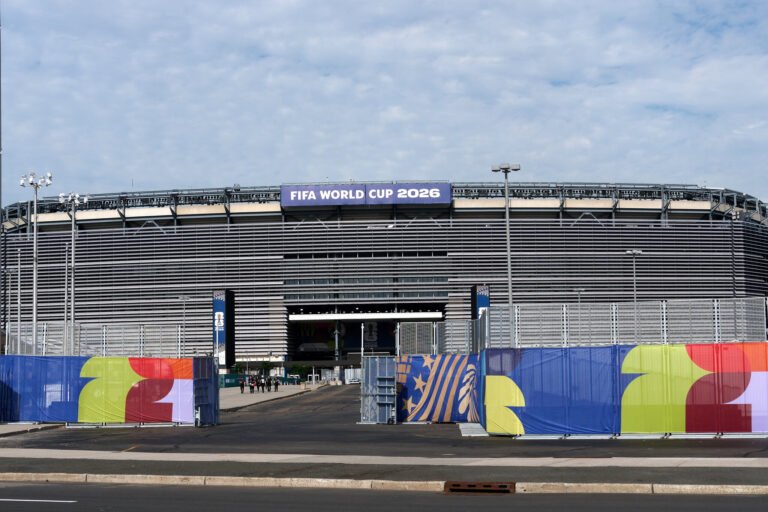
New York – United States — The organizing committees for the FIFA World Cup 2026 have unveiled an expansive portfolio of rigid security directives and operational protocols regulating spectator admission into tournament venues. This strategic deployment materializes amidst intensive, multi-nation logistical preparations to host the globe’s premier football spectacle, co-hosted by the United States, Canada, and Mexico, introducing a historic expansion to 48 national teams for the first time in tournament history.
Comprehensive Prohibited Items Registry and Drone Disqualification
The newly released guidelines detail a highly comprehensive registry of prohibited items and materials strictly barred from stadium perimeters. This preemptive layout aims to maximize public safety, mitigate operational volatility, and ensure matches and fan zones unfold within a highly secure environment for the millions of international travelers projected to arrive. The dynamic ban categorically excludes weapons of any structural variation, sharp or pointed instruments, combustible chemicals, pyrotechnics, and flares. Additionally, any accessory capable of functioning as a projectile or posing a physical hazard to spectators, athletes, or stadium personnel is completely prohibited.
Furthermore, heightened security countermeasures mandate the rejection of oversized luggage and backpacks exceeding approved dimensional profiles, unauthorized professional-grade broadcasting or audio-visual gear, and the absolute prohibition of Unmanned Aerial Vehicles (drones) within stadium airspaces. Security teams will also systematically seize signs, banners, or imagery that conflict with FIFA statutes or project political, discriminatory, or provocative messaging.
Precision Electronic Screening and Crowd Management Strategies
Organizers confirmed that bringing external alcoholic beverages, rigid glass or metallic containers, and visual-obstruction devices into the arenas remains strictly illegal. Every spectator ticket-holder will undergo rigorous electronic screening, physical inspection, and smart-gate authentication prior to clearing checkpoint terminals. The regulations also restrict high-decibel acoustic instruments capable of disrupting audiences or threatening localized public safety; only officially sanctioned fan equipment complying with regulations set forth by the organizing committee and FIFA will be permitted.
This synchronized defense matrix is engineered to cultivate a seamless, elite, and completely secure consumer environment throughout this massive rendition of the World Cup, particularly given statistical forecasts anticipating record-shattering crowds across host cities over the multi-week tournament. In this context, crowd management specialists and large-scale sports event strategists assert that tournament prestige no longer depends solely on aesthetic or technical execution, but is fundamentally tethered to the capacity of security architectures to manage vast human masses and neutralize potential threats with high operational precision. Further procedural updates regarding encrypted digital ticketing systems and smart transit corridors between cross-border host venues are slated for release in the coming months as the countdown narrows for this historic geopolitical and sporting event, which will be viewed by billions worldwide.