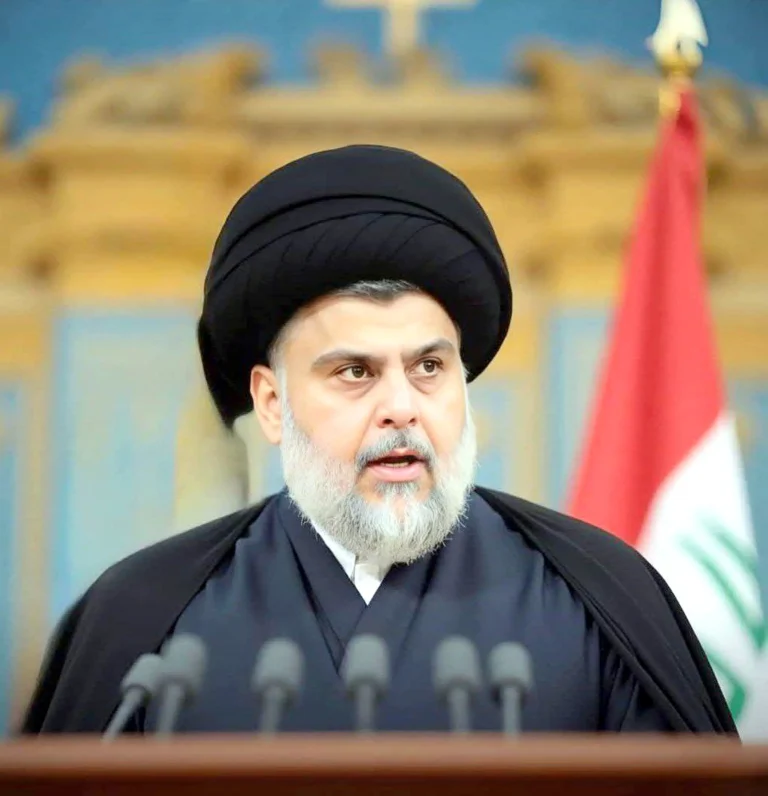
Baghdad, Iraq – Muqtada al-Sadr, leader of the Sadrist Movement, addressed new political messages to the incoming Iraqi government, calling for the disbanding of armed factions and their exclusion from the new cabinet.
This came amid escalating political disputes within the “Coordination Framework” regarding the distribution of sovereign and service-oriented ministries.
In a message to Prime Minister-designate Ali al-Zaidi, al-Sadr urged against resorting to what he termed a “hodgepodge” in forming the government.
He was referring to the system of political quotas and partisan balances that has characterized Iraqi governments since 2003.
Disagreements within the coordination framework
The Iraqi political scene is witnessing escalating tensions within the “Coordination Framework” forces,
stemming from disagreements over the distribution of ministerial portfolios, particularly the sovereign and economic ministries.
According to Iraqi political sources, the prime minister-designate has reached a preliminary agreement
with the Framework forces to present the cabinet lineup to parliament in the coming days. However, the final list is still incomplete.
The sources indicated that agreement has been reached on a number of ministerial names,
while some portfolios remain points of contention among the various political forces.
Conflict over sovereign ministries
Sources close to the coordination framework revealed that the main points of contention are within the Shia bloc, particularly regarding the ministries of oil and finance,
which have become the focus of competition among several prominent political forces.
Ammar al-Hakim, Qais al-Khazali, and Nouri al-Maliki stand out in this context.
Their efforts come amidst attempts to reach political understandings that will ensure the passage of the new government.
A complex political landscape
Recent developments reflect the complexities facing the formation of the Iraqi government,
given the intertwining of partisan calculations with sectarian and ethnic balances.
Consequently, reaching a final government formula hinges on delicate understandings among the various political factions.
Al-Sadr’s statements also come at a time of increasing regional and international pressure
regarding the future of armed groups and their role within Iraqi state institutions.
Furthermore, there are calls for a restructuring of the country’s security and political landscape.