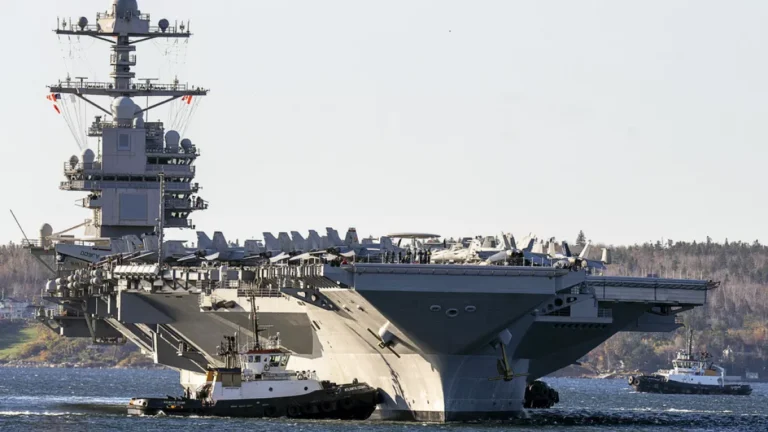
Washington, DC – In a significant move with both military and political implications, the United States announced the departure of the aircraft carrier USS Gerald Ford from the Middle East. This comes as part of what the US Department of Defense described as a “tactical repositioning” of forces. The decision is made amid rapidly evolving developments in the region.
According to Pentagon officials, the decision to withdraw the carrier does not reflect a decrease in US security commitments. Rather, it is part of a flexible plan to redeploy naval assets according to the priorities of global threats, particularly in light of escalating tensions in other regions such as the Pacific and Indian Oceans.
Officials noted that the USS Ford, the newest and most powerful aircraft carrier in the US fleet, has been fulfilling its missions in recent times, supporting regional stability and bolstering deterrence. They also pointed out that its presence served as a clear message to any attempts to destabilize the Middle East.
Observers believe this move may reflect a gradual shift in US strategy, from a heavy military presence to a more remote approach to managing influence. This is particularly relevant given Washington’s increasing reliance on allied military bases and advanced technologies for surveillance and deterrence.
Conversely, military sources did not rule out the possibility of the aircraft carrier’s return or the deployment of replacements should the situation develop unexpectedly. They affirmed that US forces still possess sufficient capabilities for rapid intervention at any time.
This move comes at a sensitive time, as the region witnesses escalating tensions. It also raises questions about the implications of this step on the regional balance of power and its significance within the context of US policy toward the Middle East in the coming period.