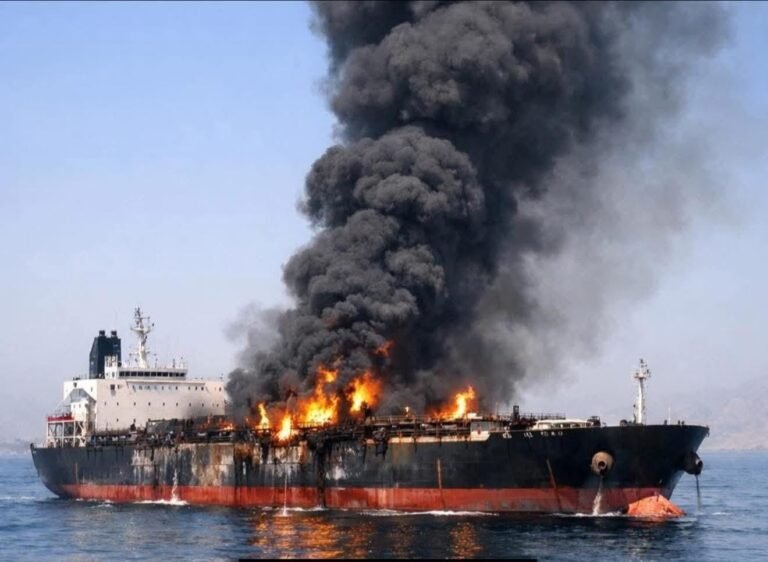
London, Britain – Reuters news agency, citing maritime security sources and the UK Maritime Trade Operations (UKMTO), reported that at least three container ships were attacked in the Strait of Hormuz on Wednesday. This threatens the stability of global trade through this vital waterway.
Details of the attack on the Liberian ship
According to reports, the most severely damaged vessel was flying the Liberian flag and was targeted by heavy machine gun and rocket fire in the area northeast of Oman.
Sources confirmed that an Iranian Revolutionary Guard Corps (IRGC) speedboat approached the vessel and opened fire directly, causing damage to part of the ship’s bridge.
Despite the intensity of the attack, the UK’s maritime operations center reported that all crew members were safe. No fires or environmental pollution were detected. However, the vessel was forced to stop to assess the damage.
Ships flying the flags of Panama and Liberia were targeted.
The attacks were not limited to the first vessel; Reuters added that a second container ship, flying the Panamanian flag, was also fired upon in the same area. However, it escaped with minimal damage and continued its voyage after its crew was confirmed safe. In a third, separate attack, another ship, flying the Liberian flag, was targeted by gunfire approximately eight nautical miles west of the Iranian coast. This led to its temporary detention for structural integrity checks. Reports confirmed that the entire crew survived.
Security and economic repercussions
These attacks come at a highly sensitive time, coinciding with the approaching end of the ceasefire declared by US President Donald Trump and the failure of rounds of negotiations aimed at guaranteeing freedom of navigation in the Strait.
Observers believe that the return of the Revolutionary Guard’s fast boats to target commercial vessels represents a direct Iranian pressure tactic in response to the recent sanctions imposed by the US Treasury Department on Tehran’s arms networks. The repeated attacks in the Strait of Hormuz, through which approximately one-fifth of the world’s oil consumption passes, are driving up maritime insurance costs and increasing the risk of supply chain disruptions.
With the continued targeting of ships flying international flags, the international community faces a significant challenge in securing waterways, especially given Washington’s threats to resume military action in response to any “reckless behavior” that threatens global energy security and freedom of international navigation in this strategic waterway.