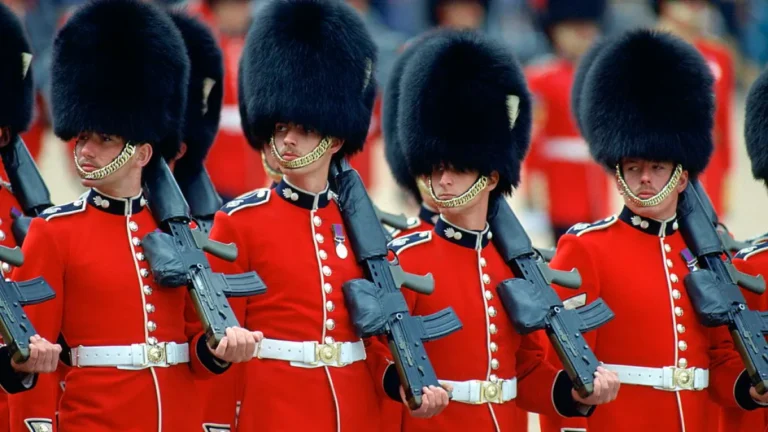
London, England – In a scene seemingly far removed from the battlefields of Ukraine, Britain has reconsidered one of its most iconic military symbols: the Berskin hats worn by the Royal Guard, traditionally made from real bearskin. This decision wasn’t simply a response to environmental or human rights pressures; it was part of a broader context. It reflects how modern warfare is forcing militaries to re-examine even the smallest details, including those that appear traditional or symbolic.
The war in Ukraine has not only altered combat tactics but has also imposed a new reality on European armies, one based on rapid adaptation. Furthermore, this new reality has spurred a shift away from complex or expensive resources and a search for more sustainable and flexible alternatives. Within this framework, Britain has begun seriously considering the use of advanced synthetic materials instead of natural fur. This shift has been particularly influenced by supply chain disruptions and rising costs associated with animal products.
The famous Berskin hats, worn by the Royal Guard, have traditionally been made from Canadian bearskin, a practice that has long been a point of contention between animal rights advocates and the military establishment. This time, however, the motivation is no longer solely ethical but also practical. In a world where supply chain rules are changing rapidly, and where sustainability is becoming part of national security, the need for change is paramount.
Trials conducted by the British Ministry of Defence on alternative materials have shown promising results, with some synthetic fibers remarkably mimicking the look and feel of the uniform, while offering the added advantages of durability and lightweight construction. These developments have opened the door to a broader discussion within the military establishment about modernizing the uniform without compromising its historical identity.
Although a final decision has not yet been reached, the general trend suggests that Britain, like other nations, no longer views tradition in isolation from strategic realities. The lessons learned from the war in Ukraine have underscored that adaptability, even in the smallest details, can be part of the equation of power.
Thus, a traditional cap becomes a symbol of a new era, where symbolism blends with pragmatism, and preserving the image depends on the ability to change, not on blindly clinging to the past.