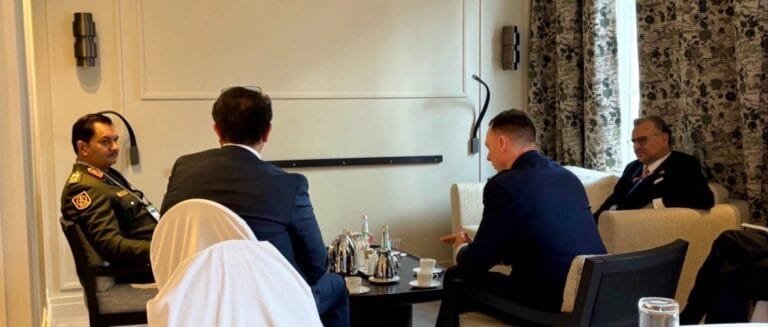
Munich, Germany – In a move described as a major turning point towards ending a decade of military division, Munich hosted a high-level meeting Monday morning between Massad Boulos, senior US advisor on Arab and African affairs, Field Marshal Saddam Haftar, deputy commander of the Libyan National Army, and General Dagvin Anderson, commander of US Africa Command (AFRICOM).
Details of the Munich meeting
Following a meeting held on the sidelines of the Munich Security Conference (MSC 2026), Massad Boulos stated that he had a “productive meeting” with the Deputy Commander of the Libyan National Army and the Commander of AFRICOM. Discussions focused on the strategic importance of the upcoming Flintlock exercises in Libya and explored concrete steps to enhance military integration between eastern and western Libya. The participants also finalized arrangements for Libya to host a major component of Flintlock 2026, marking the first time this massive international counterterrorism exercise will be held on Libyan soil, specifically in the coastal city of Sirte.
From Munich to Sirte: Diplomacy of “Military Ranks”
Today’s Munich meeting comes as a continuation of diplomatic momentum that began yesterday, Sunday, when Field Marshal Saddam Haftar met bilaterally with General Dagfinn Andersson. This rapid succession of events also indicates that solid agreements have been reached behind closed doors to overcome political obstacles through “field integration.” According to the General Command’s media office, Saddam Haftar’s participation in the Munich conference included a series of meetings with international officials. During these meetings, he held discussions on the latest developments in Libya and ways to enhance cooperation on issues of mutual interest.
Implications of the American move for 2026
Observers believe that the vision of the Washington administration, represented by Massad Boulos, is based on a strategy of “stability through military integration.” Furthermore, it appears that the United States has decided to rely on “military diplomacy” as an essential approach to securing energy flows and combating terrorism. This decision was made bypassing the complexities of traditional political approaches, which have been stalled for years.