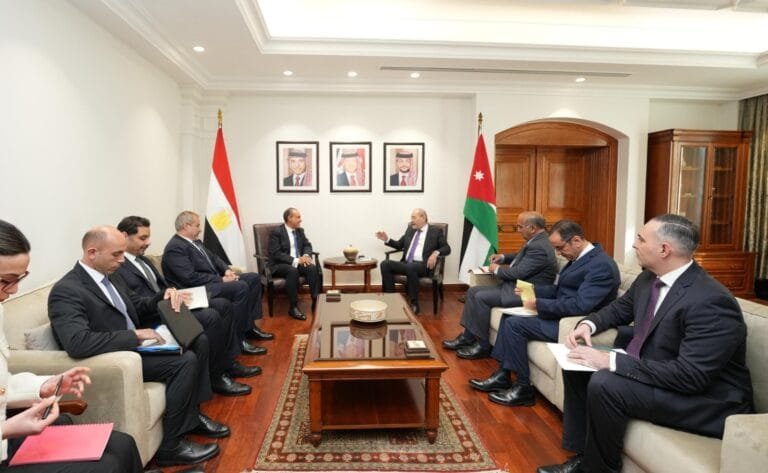
Amman, Jordan – Jordanian Deputy Prime Minister and Foreign Minister Ayman Safadi held extensive talks with Egyptian Foreign Minister Badr Abdel-Aty in Amman. The two ministers affirmed the deep-rooted historical ties and fraternal bonds between their countries, and their mutual commitment to strengthening and developing these relations across various fields and sectors, particularly in the economic and investment spheres. They also emphasized the importance of building upon existing coordination mechanisms and elevating them to broader levels. The ministers further noted the brotherly relationship between Egyptian President Abdel Fattah al-Sisi and Jordanian King Abdullah II bin Al-Hussein. They commended the ongoing coordination and consultation between the two countries on issues of common interest, which contributes to advancing bilateral cooperation and serving their shared interests.
The two ministers also discussed developments in the region, particularly the situation in the Gaza Strip. They emphasized the need for full adherence to the ceasefire agreement and its implementation in accordance with the plan of US President Donald Trump. This includes the immediate, sufficient, and sustained delivery of aid to the Strip. Furthermore, they stressed the importance of paving the way for the Palestinian Authority to resume its responsibilities and preserving the unity of Palestinian territory between the West Bank and Gaza. In this context, the two ministers emphasized the need to move towards a clear political horizon. This path leads to an independent and sovereign Palestinian state within the June 4, 1967 borders, with East Jerusalem as its capital, based on the two-state solution and relevant UN resolutions.
The two ministers reiterated their welcome of the formation of the Palestinian National Committee for the Administration of the Gaza Strip, the announcement of the second phase of the Comprehensive Peace Plan, and the launch of the US Peace Council. They affirmed their commitment to supporting the Council’s implementation of its tasks as a transitional body in accordance with the Comprehensive Plan. The ministers also emphasized their commitment to UN Security Council Resolution 2803. They warned of the dangers of illegal Israeli measures in the occupied West Bank, which could lead to an escalation of the situation and undermine efforts to achieve de-escalation and the prospects for a just peace based on the two-state solution. Furthermore, the ministers affirmed that this is the only path to achieving security, stability, and lasting peace in the region. The meeting addressed a number of issues of common interest. In conclusion, the two ministers affirmed their continued cooperation and coordination to contribute to strengthening regional security and stability and serving Arab causes.