
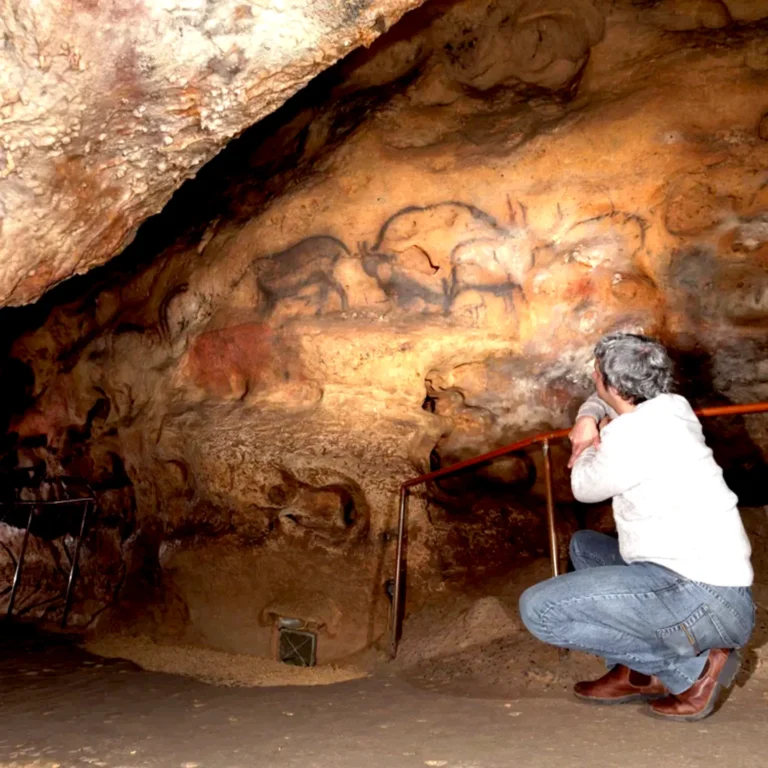
Dordogne, France – A team of researchers has made new findings that help determine the age of the paintings and engravings found inside the Font-de-Gôme cave in France, one of Europe’s most famous rock art sites.
This discovery has ended a long-standing mystery surrounding the age of these works.
The scientists used modern scientific techniques to analyze the materials used in some of the paintings.
This allowed them to obtain more accurate estimates of the artwork’s age,
rather than relying solely on historical and artistic comparisons.
The importance of discovery
The results showed that some of the drawings date back more than 13,000 years.
Other analyses indicate even older works, confirming that the cave was not the site of a single artistic period.
On the contrary, the cave witnessed repeated human activity over different time periods.
The Font-de-Gôme cave contains hundreds of drawings and engravings depicting animals, including bison, deer, and horses.
Therefore, it is considered one of the most important sites documenting prehistoric human art.
The significance of the discovery lies in the opportunity it provides researchers to understand the evolution of rock art and its stages.
It also helps to understand the conditions that led ancient humans to choose caves to record their scenes and symbols.
Other works inside the cave
Researchers believe the new findings could pave the way for further studies of other artworks within the cave.
These results might also help re-evaluate the ages of paintings found at similar archaeological sites.
More than a century after the cave paintings were discovered, its walls continue
to reveal new secrets about the lives of ancient humans and their capacity for artistic expression.
Thus, the cave walls confirm that some of the oldest artworks in Europe still hold questions that science has yet to fully answer.