Giza, Egypt – Thousands of years before the emergence of modern literature in ancient civilizations, the ancient Egyptians left behind religious
and poetic texts that are among the oldest literary examples to have survived to modern times.
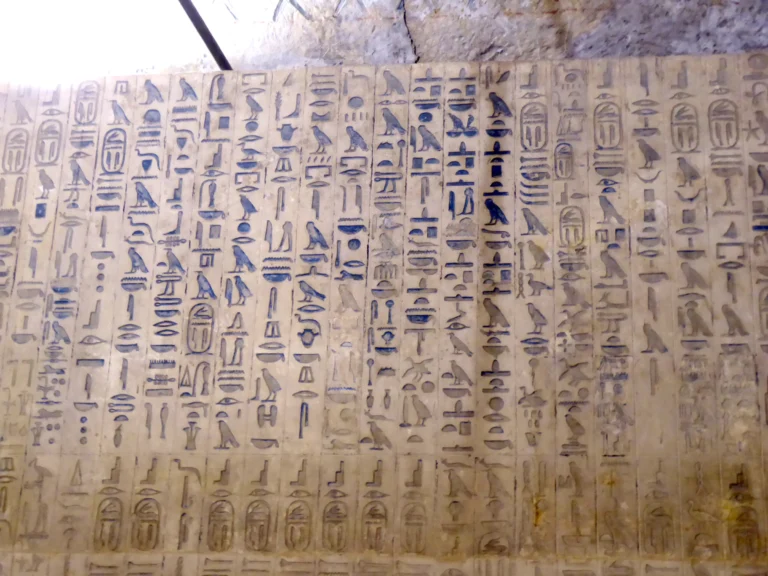
Among the most prominent are the Pyramid Texts, inscribed on the walls of chambers within some pyramids during the Old Kingdom.
The Pyramid Texts comprise a vast collection of spells, hymns, prayers, and funerary texts.
The ancient Egyptians used them in rituals related to burial, resurrection, and the afterlife.
It was believed that these sacred words would help the deceased king pass on to the ext world.
A literary language rich in imagery and metaphors
These texts are characterized by a rich literary language, replete with imagery, metaphors,
repetition, and rhythm, and include hymns addressed to the gods.
They also contain texts describing the king’s ascension to heaven,
his union with the gods, and his resurrection after death.
The Pyramid Texts are among the oldest known religious texts of ancient Egypt.
They emerged prominently during the late Fifth Dynasty and early Sixth Dynasty.
Later, funerary traditions evolved into other texts such as the Coffin Texts and the Book of the Dead.
The importance of these texts lies not only in their antiquity but also in the insights they offer into
the ancient Egyptian mindset and their understanding of death, resurrection, the cosmos,
and the relationship between humanity and divine forces.
A society that recognized early on the power of words
The hymns and prayers inscribed on the walls also reveal the ancient Egyptians’ ability
to use language to express feelings of fear, hope, supplication, and the desire for immortality.
This gives them a literary value that transcends their religious function.
Despite the passage of thousands of years, the Pyramid Texts remain an important source
for the study of ancient Egyptian language, literature, religion, and funerary beliefs.
They offer one of the oldest windows into the world of the ancient Egyptians and their ideas about life, death, and immortality.
While languages and civilizations have changed, these words carved in stone have endured as
a testament to a society that recognized the power of language early on.
They used language to document their beliefs, fears, and dreams of immortality.