Cairo, Egypt – Social media platform names are no longer mere technical terms; they have become part of everyday language.
This has prompted linguistic institutions to search for Arabic equivalents for these terms and their derivatives.
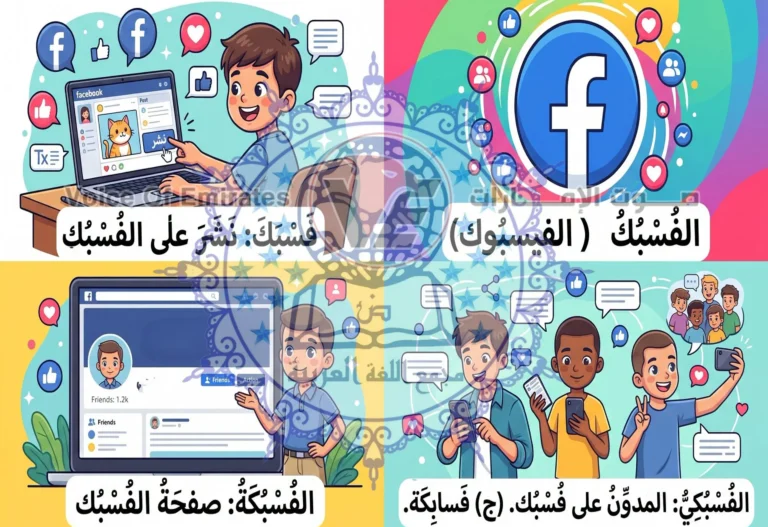
Among these terms is “Facebook.” The Arabic Language Academy in Cairo has proposed an Arabic equivalent, “al-fasbak,”
in an attempt to formulate a word that preserves the original pronunciation of the name
while remaining accessible within the structure of the Arabic language and usable in various expressions.
New words are emerging at an accelerated rate
The concept of Arabization is based on transferring foreign terms
into Arabic in a way that aligns with Arabic pronunciation and writing,
rather than a literal translation that might deviate from the globally used term.
This isn’t limited to the name itself. The greatest challenge arises when dealing with its related derivatives,
such as user, page, post, publishing process, and interaction.
These are all terms that have become ubiquitous in media and social discourse.
The selection of “Facebook” reflects one aspect of the Arabic Language Academy’s efforts
to address newly coined terms brought about by technological advancements,
especially given the rapid emergence of new words for which finding a common Arabic equivalent is sometimes difficult.
The Arabic language faces a continuous challenge
Arabization remains a contentious issue among linguists and users alike. Some terms quickly find their way into common usage,
while others remain confined to dictionaries and linguistic conventions due to the public’s attachment to the original foreign term.
With the massive proliferation of social media platforms, the Arabic language faces a constant challenge in absorbing new digital terminology.
This occurs through translation, Arabization, or the creation of entirely new terms that suit the nature of the language.
Thus, the story of “Facebook” is not simply a change in the spelling of a popular platform’s name.
Rather, it exemplifies the Arabic language’s attempt to keep pace with a rapidly changing digital world
while simultaneously preserving its grammatical rules and its capacity to generate new vocabulary.