
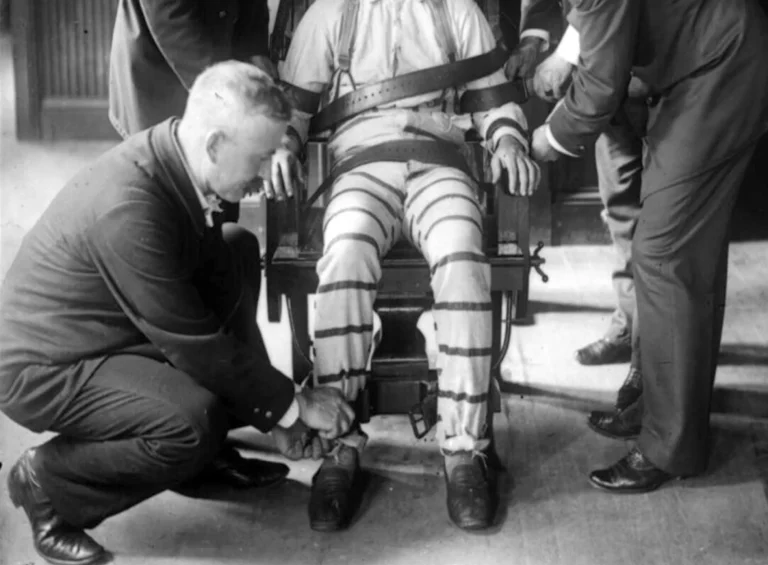
Auburn, USA – The year 1890 witnessed one of the most controversial episodes in the history of criminal punishment. American William Kimbler became the first person in the world to be executed by electric chair.
The experiment was considered at the time to be a more “humane” method of execution compared to hanging. However, it sparked widespread criticism following the details of the execution.
An attempt to develop methods for carrying out death sentences
Kimbler had been convicted of murdering his common-law wife, Tilly Ziegler, with an axe. He was sentenced to death under a new New York State law that replaced hanging with the electric chair, an attempt to modernize execution methods.
On the morning of August 6, 1890, the sentence was carried out at Auburn State Prison in New York.
Kimbler was strapped into the electric chair, and an electric current, which officials believed would be sufficient to end his life quickly, was applied.
However, the first attempt failed. A stronger current was administered again, to the shock of onlookers.
A landmark in the history of criminal justice
The incident sparked widespread reactions in legal, medical, and media circles, with several witnesses describing what happened as more brutal than anticipated.
Others argued that the experience highlighted the need to refine procedures related to the use of the electric chair.
Despite the controversy surrounding the first execution, several US states later adopted the electric chair as an official method of carrying out executions.
In subsequent decades, many states turned to other methods, most notably lethal injection.
Nevertheless, legal and human rights debates surrounding the death penalty in general have persisted.
The case of William Kimbler remains a landmark in the history of criminal justice, as his name is associated with the first use of the electric chair.
This incident also opened a broad debate about the ethics of capital punishment and the limits of evolving methods of punishment.