
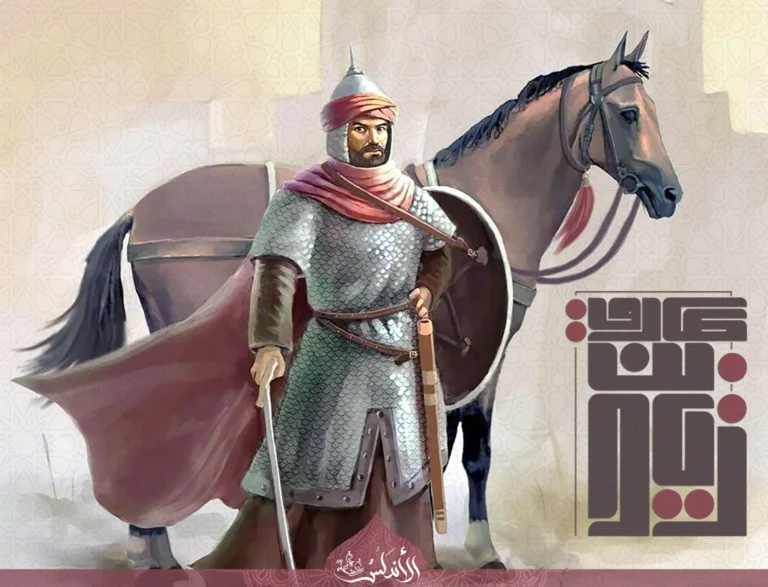
Cordoba, Spain – The Battle of Guadalete, fought in 711 CE, is considered one of the most important battles in Islamic and European history.
It marked a turning point that paved the way for the conquest of Al-Andalus,
after Muslim forces led by Tariq ibn Ziyad defeated the Visigothic army under King Roderic.
This victory opened the door to a new era that lasted for nearly eight centuries in the Iberian Peninsula.
The campaign began after Tariq ibn Ziyad crossed the strait separating North Africa
from the Iberian Peninsula at the head of an army of thousands.
He then reached the rock that would later be known as Gibraltar.
After securing his forces’ positions, he advanced to confront the Visigothic army, which outnumbered him.
The battle lasted several days and ended in a decisive Muslim victory.
Political conflicts and divisions
Historians believe that this victory was not solely due to military superiority.
Political divisions within the Visigothic kingdom and conflicts among its nobles also contributed.
Furthermore, Tariq ibn Ziyad’s astute military planning and exploitation of the terrain played a significant role.
The fall of King Roderic during the battle led to the collapse of organized Visigothic resistance.
As a result, Muslim forces were able to advance rapidly and capture key cities
such as Cordoba and Toledo, the capital of the Visigothic kingdom.
The conquests continued to expand in the following years under
the leadership of Musa ibn Nusayr and his commanders.
A stage of cultural flourishing
With the establishment of Islamic rule in Andalusia, a period of cultural flourishing began,
encompassing science, medicine, astronomy, engineering, philosophy, and architecture.
Cities like Cordoba, Seville, and Granada transformed into scientific and cultural centers
that attracted scholars and students from around the world.
The Battle of Guadalete remains one of the most significant historical events
that reshaped the political map of Western Europe.
It was not merely a military confrontation, but the beginning of a cultural era
that left a profound mark on the history of Spain and Europe.
It also contributed to the transmission of much knowledge and science
to the European continent via Andalusia.