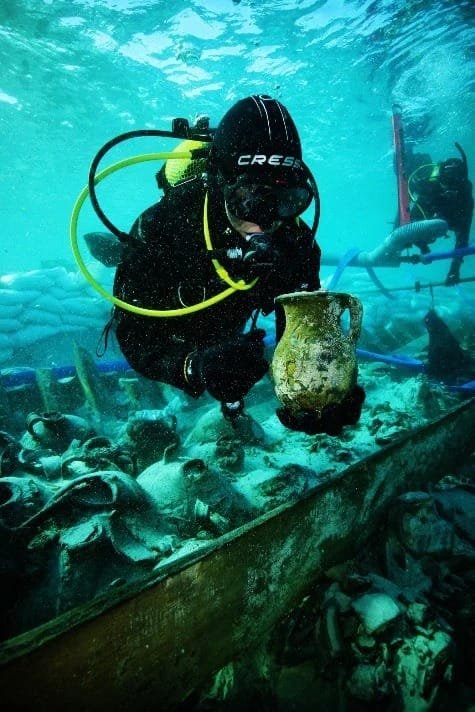
Mallorca, Spain – After years of intensive efforts and precise research beneath the depths of the sea, the Council of Mallorca (Consell de Mallorca) announced the completion of the recovery operation for the famous Roman shipwreck “Ses Fontanelles,” dating back to the 4th century AD. This operation, carried out under the “Arqueomallornauta” program, marks a milestone in underwater archaeology, as the wreck represents one of the best-preserved discoveries from the late Roman era in the western Mediterranean.
A Time Capsule Under the Sediment
The ship was discovered in 2019 off the coast of “Playa de Palma” in Mallorca, at a shallow depth of only a few hundred meters from the shore. Thanks to the nature of the marine sediments that covered it for centuries, the ship’s structure and a large portion of its cargo and equipment remained in an exceptional state of preservation, serving as a time capsule from the past.
Archaeological Treasures Reflecting Daily Life
The excavation and recovery process yielded hundreds of precious artifacts that provide stunning details about the lives of Roman sailors. Highlights include:
- A huge collection of amphorae: Pottery jars used to transport food and liquids across the seas.
- Maritime equipment: Two iron anchors and 90 meters of remarkably preserved rope.
- Organic materials: Pieces of original linen used in the ship’s sails, as well as footwear.
- Craft tools: Including a drill-like tool, reflecting the craftsmanship of that era.
- Coins: Helping to date the period when the ship sank.
A Window into Ancient Trade
The importance of “Ses Fontanelles” lies not only in its artifacts but in its role as a living historical document of Roman maritime trade. The inscriptions and markings on the jars provide precise information about global trade routes at the time and how maritime transport was organized during a pivotal period of major shifts within the Roman Empire.
Precise Scientific Collaboration
The recovery process required close cooperation between a multidisciplinary team including underwater archaeologists, restoration specialists, and marine biologists. Each piece was handled with extreme caution, and organic materials—especially the submerged wood—underwent special conservation procedures to prevent deterioration upon exposure to air and surface atmospheric pressure.
Beyond Recovery: Research and Analysis Phase
With the extraction of the wreck complete, the most complex phase begins: all recovered pieces will undergo delicate restoration and intensive laboratory analysis. Scientists aim to reconstruct the historical path of the ship, determine the precise causes of its sinking, and study ancient Roman shipbuilding techniques. Researchers hope these results will reveal new details about the cultural and economic identity of Mallorca during the 4th century AD, which will undoubtedly enrich our understanding of ancient Mediterranean history.