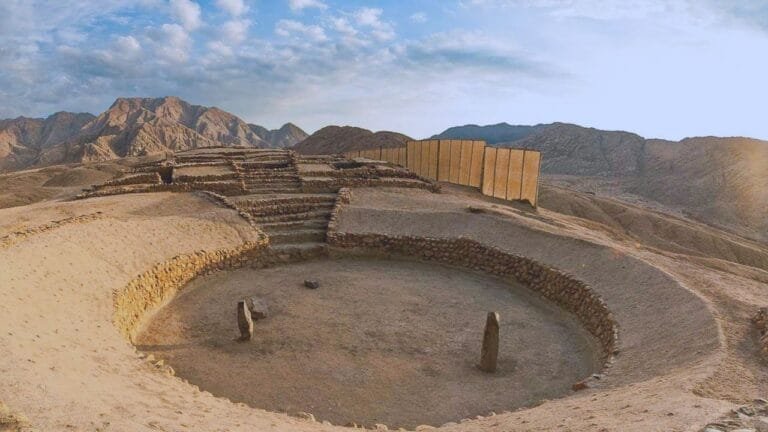
Peru – In an archaeological discovery that has shaken scientific circles, researchers in Peru have announced the finding of what is believed to be the oldest known astronomical observatory in the Americas. Obviously, as of May 2026, this discovery shifts the narrative regarding pre-Incan capabilities; the mountain site reveals a profound genius in understanding the movement of stars and planets, proving that ancient South American peoples possessed a highly accurate “celestial calendar” centuries before modern civilization.
“Light Engineering”: How Ancient Peoples Harnessed the Sun for Agriculture
Analysts clarified that the discovered site was not built by chance; it was designed with precise geometric orientation aligned with the sunrise and sunset at specific times of the year. Accordingly, these civilizations used the observatory as a “compass” to organize planting seasons and schedule religious and social rituals. Clearly, astronomical knowledge in that era was not merely myth but relied on rigorous scientific observation and repeated experimentation that allowed them to build complex, organized life systems.
“Reading the Skies”: Were Pre-Inca Civilizations More Advanced Than Imagined?
Archaeology experts believe this observatory represents a qualitative addition to the history of science; it confirms that ancient humans in these regions had a remarkable ability to employ astronomy in their daily lives. As a result, this find opens the door to re-evaluating the scientific history of the Americas, indicating that ancient peoples “read the sky” with intelligence matching the greatest civilizations of the East. In this landscape, the new site remains a puzzle that scientists are eager to fully decode to understand how the ancients managed their lives under the starlight.