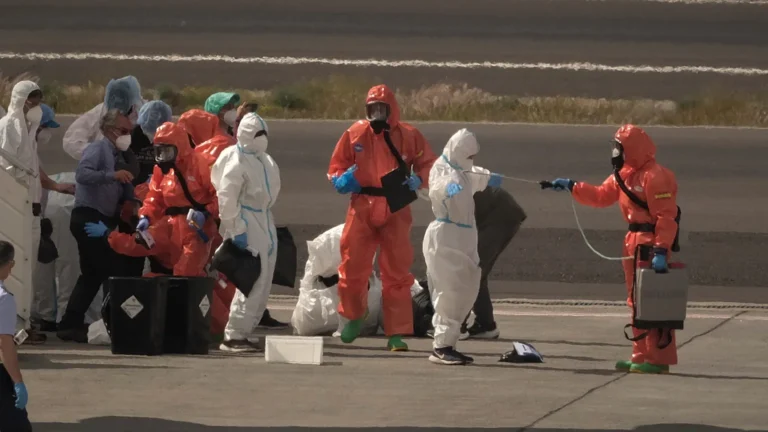
Rotterdam, Netherlands – The cruise ship MV Hondus, infected with the deadly Hantavirus, is scheduled to arrive in the Dutch port city of Rotterdam on Monday morning. It is arriving amidst strict health measures and a state of high alert among medical authorities. This comes in response to this exceptional epidemiological challenge that has sparked widespread international concern.
Isolation and evacuation journey for passengers to 20 countries
The cruise ship MV Hondios spent the last six days on a continuous voyage from the Canary Islands. A complex evacuation operation took place, with the remaining passengers disembarking accompanied by a specialized medical team wearing full personal protective equipment (PPE) to protect them from infection. Following disembarkation, the passengers boarded international flights to more than 20 different countries. The aim was to undergo mandatory quarantine in their home countries and closely monitor their health status.
According to the latest data from the World Health Organization, the total number of infections on board the ship has reached 11. Nine of these have been laboratory-confirmed so far.
The tragic voyage has claimed the lives of three passengers, including a Dutch husband and wife. Health officials and epidemiologists believe they were the first to be exposed to the deadly virus during a tourist trip to South America before boarding the ship.
Pasteur Institute decodes the virus’s genetic code
In the context of scientific efforts to contain the crisis, the Pasteur Institute in France revealed significant laboratory developments on Saturday. It announced its success in fully sequencing the genome of the Andean strain of Hantavirus, which was detected in a French passenger who had been aboard the cruise ship.
The institute confirmed that the strain is identical to previously known South American viruses. It also indicated that there is no evidence or scientific indication to date of a genetic mutation that would make the virus more transmissible or more dangerous to human life.
In this regard, French Health Minister Stéphanie Rieste reassured the public in a statement published Friday on the X platform, saying: “The strain analyzed matches viruses already known and monitored in South America.”
Rieste added: “At this stage, there is no indication of a mutation of the virus that could be more contagious or more dangerous.”
97% genetic match with rodent strains
The Pasteur Institute explained that in-depth genetic analysis confirmed that the virus detected in the French passenger matched the virus found in other cases on board the ship. It also closely resembled, by up to 97 percent, the Andean strain that occurs naturally in rodents in South America.
For his part, Jean-Claude Manoguera, head of the Infectious Diseases and Ecology Unit at the Pasteur Institute, stated that the remaining 3 percent variation is a natural viral variability that does not affect the virus’s characteristics. He emphasized that sharing this data with the international scientific community will ensure continued close monitoring of the situation.