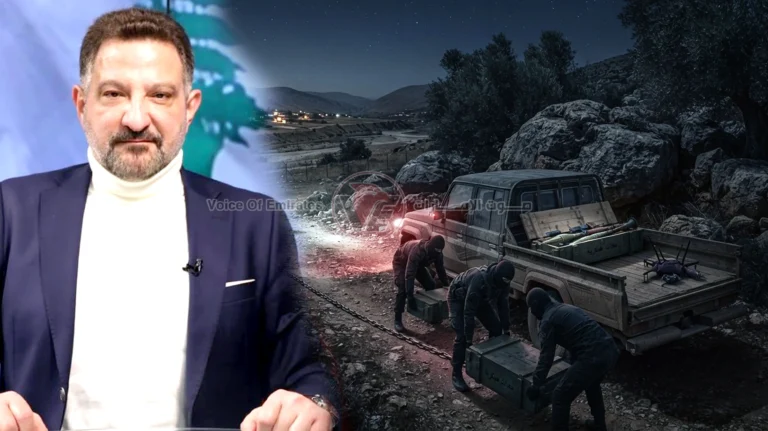
Exclusive, Voice of the Emirates – In an exclusive statement to Voice of the Emirates, researcher and political analyst Tariq Abu Zeinab offered an in-depth analysis of the volatile border situation between Syria and Lebanon.
He emphasized that we are witnessing a qualitative shift that transcends mere traditional smuggling activity.
It has become a pivotal struggle for regional sovereignty.
Researcher and political analyst Tariq Abu Zeinab affirmed that
the issue of arms smuggling from Syria to Lebanon has transformed, in the post-Assad era,
into one of the most prominent aspects of the security conflict in the region.
Regional calculations that transcend borders
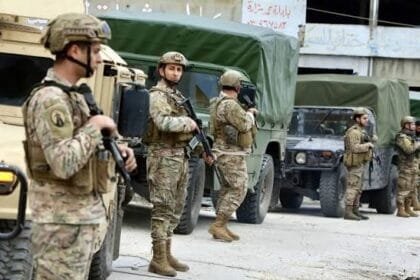
Abu Zeinab explained that the border, which for years had been an open artery for the transfer of weapons, ammunition,
and prohibited materials, has now become a real battleground between the Syrian state’s ambition
to restore its sovereignty and its efforts to close the avenues of chaos.
Meanwhile, desperate smuggling networks are attempting to revive
the old supply routes that have fueled the Lebanese interior for decades.
Abu Zeinab pointed out that the recent seizures of weapons shipments are not merely isolated security incidents,
but rather a strategic indicator of a broader shift in the balance of control over the border.
He noted that closing these routes represents a serious attempt to end
a historical phase in which the Syrian-Lebanese border was used as a conduit
for regional calculations that transcended the national borders of the two countries.
Hezbollah’s last attempt to rebuild its capabilities
In his analysis of the developments on the ground, Abu Zeinab noted
that Hezbollah is in a race against time to recover its remaining military stockpiles inside Syrian territory.
This includes stockpiles located along the Syrian-Lebanese and Syrian-Iraqi borders.
He indicated that this is a last-ditch effort to rebuild its capabilities,
which have been diminished by regional changes and recent losses.
He explained that the Syrian state has placed this issue among the top priorities of its new government,
especially after security information confirmed that smuggled shipments
included sophisticated weapons, such as long-range missiles, anti-tank missiles, and drones.
This was demonstrated in the incident where missiles were thwarted
while being smuggled inside an oil tanker bound for Banias.
Coordination between Damascus, Beirut and Baghdad
Regarding international pressure, Abu Zeinab noted that this issue coincides with escalating American pressure.
President Donald Trump is pushing for a more assertive Syrian role,
even raising the possibility of military intervention to disarm Hezbollah.
However, Damascus officially denies such possibilities.
At the same time, Abu Zeinab revealed a significant development in coordination
between Damascus and Baghdad to track down those involved.
He also mentioned coordination between Damascus and Beirut
regarding information on smuggling networks and the closure of illegal border crossings.
Complex challenges and a test for the Syrian state
According to Abu Zainab’s estimates, the Syrian state has succeeded
in establishing control over approximately 75 percent of the shared border.
However, the challenge remains in the remaining gaps in rugged terrain,
such as the Homs countryside (al-Qusayr and Talkalakh) and the Qalamoun region (al-Zabadani and Assal al-Ward).
According to the researcher, Syrian security forces face complex challenges,
as local networks possess extensive experience navigating these difficult areas.
Therefore, continuous reinforcement of human and technological capabilities is required.
Abu Zainab concluded his statement to the “Voice of the Emirates” website
by emphasizing that the border battle today transcends the security dimension;
it is a true test of the Syrian state’s ability to impose its absolute sovereignty
and close the most prominent arms supply lines in the region,
amidst regional and international pressures aimed at ending the era of “open borders”
and fundamentally redrawing the security map between Syria and Lebanon.