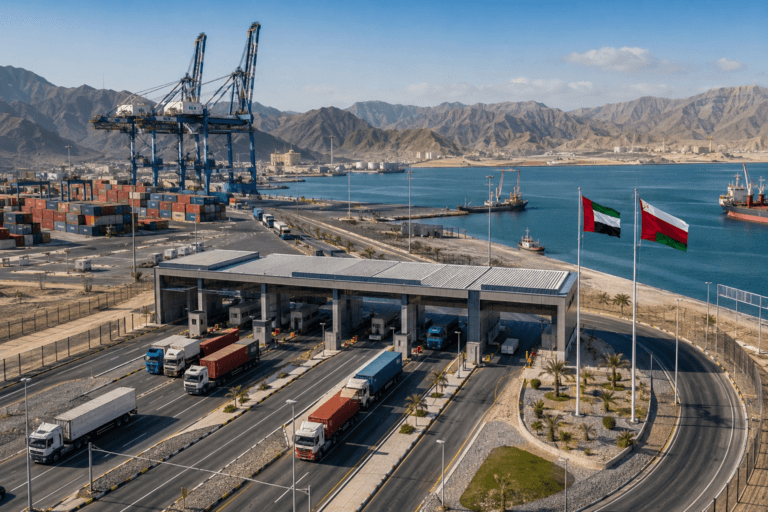
Sharjah, United Arab Emirates – The Sharjah Ports, Customs and Free Zones Authority has announced the launch of an integrated logistics corridor with the Sultanate of Oman, in coordination with Omani Customs, to connect Sharjah’s ports with Omani ports through the emirate’s land border crossings. The initiative aims to enhance supply chain efficiency and provide broader options for regional trade movement. The corridor includes the ports of Sohar, Duqm and Salalah, with Sohar Port serving as a key gateway due to its geographic proximity to the UAE.
First Shipments Operated Through Khatmat Malaha
The corridor officially began operations on May 14, 2026, after the completion of technical and coordination requirements among the relevant authorities. The first shipments departed from Port Khalid in Sharjah to Sohar Port through the Khatmat Malaha border crossing in Kalba. The corridor mainly operates through the Khatmat Malaha and Al Madam crossings, creating a direct link between ports and commercial centers in the UAE and the Sultanate of Oman, and enabling smoother two-way cargo movement.
Customs Facilities to Accelerate Cargo Flow
The corridor includes a package of operational and customs procedures, most notably the completion of customs clearance directly at Sharjah’s border crossings without the need for additional transport stages. It also includes fast-track shipment processing, pre-processing of data, direct transport under customs supervision, and data exchange between both sides. These mechanisms aim to reduce transit time, lower land transport costs, and improve the efficiency of cargo movement for companies, factories and free zone establishments.
Strategic Dimension Linked to Alternatives to the Strait of Hormuz
The initiative carries a strategic dimension that goes beyond being a new trade route between Sharjah and Oman. It strengthens the UAE’s measures to diversify logistics corridors and reduce the sensitivity of supply chains to any potential disruptions in vital maritime passages, foremost among them the Strait of Hormuz. The strait is one of the world’s most important energy transit points, with average oil flows through it in 2024 reaching around 20 million barrels per day, equivalent to about 20% of global petroleum liquids consumption.
In this context, the Sharjah-Oman corridor aligns with the UAE’s broader approach to enhancing supply chain resilience by developing alternative corridors, expanding regional integration, and adopting advanced customs and operational solutions. In April 2026, the UAE affirmed its efforts to improve the efficiency of alternative routes, including the ports of Fujairah and Khorfakkan, and to strengthen regional maritime connectivity to ensure the continuity of shipping movement. As such, the new corridor does not represent a standalone alternative to the Strait of Hormuz, but rather an additional link within a growing UAE network of logistics options that combines ports, land border crossings, fast customs procedures, and connectivity with Omani and regional markets. It also reinforces Sharjah’s position as a regional logistics hub and supports the country’s ability to respond with greater flexibility to geopolitical and commercial developments in the region.