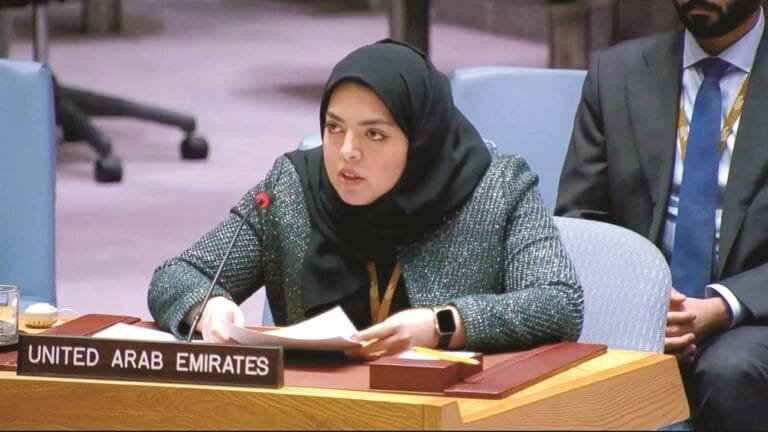
New York, United States – The UAE affirmed its firm commitment to supporting the rule of international law.
She stressed the importance of political will, consistency of efforts with the United Nations Charter, settling disputes by peaceful means, and enabling states to fulfill their international legal obligations.
The UAE reiterated in a statement during the Security Council’s open debate on reaffirming the rule of law at the international level.
Statement by Fatima Youssef, Acting Deputy Permanent Representative of the State to the United Nations, firmly affirmed support for the rule of international law.
The statement said: «Strengthening the rule of law is not just a moral duty, but a practical necessity for harmonious cooperation within and among states, a cornerstone of accountability, and a fundamental principle at the heart of our international system. Without the rule of law, justice becomes a selective tool, peace is difficult to maintain, and multilateral action falters».
The statement stressed that supporting the rule of law requires political will, especially in times of increasing geopolitical tension.
He stressed the need for Member States’ actions to be guided by the United Nations Charter.
The statement said: «Relevant countries and UN bodies must respond appropriately to any violations of the basic principles of international law, regardless of the interests or regions affected. Otherwise, it threatens to undermine the fragile fabric of our multilateral system».
The statement stressed the need for the Security Council to consistently support international law and to warn against the use of the veto «veto» in cases where its use undermines international law.
He stressed the importance of keeping the principle of peaceful settlement of disputes as the basis whenever disputes arise between countries.
He pointed out that in such cases, countries have access to a range of dispute settlement mechanisms, including recourse to the International Court of Justice.
He said: «The large number of advisory proceedings and disputed cases heard by the Court reflects States’ confidence in the Court’s ability to carry out its mandate effectively. However, States should treat the Court responsibly and not burden it with trivial issues».
Understanding international legal obligations
The statement pointed out the importance of countries being able to strengthen their capabilities to ensure that international legal obligations are properly understood and fulfilled.
He added: «When member states meet to set rules or standards, the ability of states to meet those standards is not always taken into account. We have a common interest in ensuring that States are able to fulfill their legal obligations, because non-compliance undermines the rule of law. Therefore, the international community should continue to provide technical support to States, in line with their national priorities».
At the conclusion of the statement, the UAE stressed that when international law and politics are compatible, they reinforce each other, and that countries contribute to the formulation of international law not only through concluding treaties but also through the political choices they make to support the rule of international law.