- 1979–1994: The beginning with asset freezes and trade isolation.
- 1995–2005: Oil enters a cycle of pressure
- 2006–2010: Sanctions take on an international dimension
- 2011–2013: The most severe economic blow before the nuclear agreement
- Oil: The Most Sensitive Issue
- 2013–2017: The nuclear agreement and the détente phase
- 2018–2020: The return of “maximum pressure”
- 2020–2024: Iran adapts to sanctions
- 2025.. The return of international sanctions
- 2026… Sanctions enter a different phase
- Four decades of sanctions… what has changed in the Iranian economy?
- Sanctions and oil: the most obvious link
- From sanctions to a parallel economy
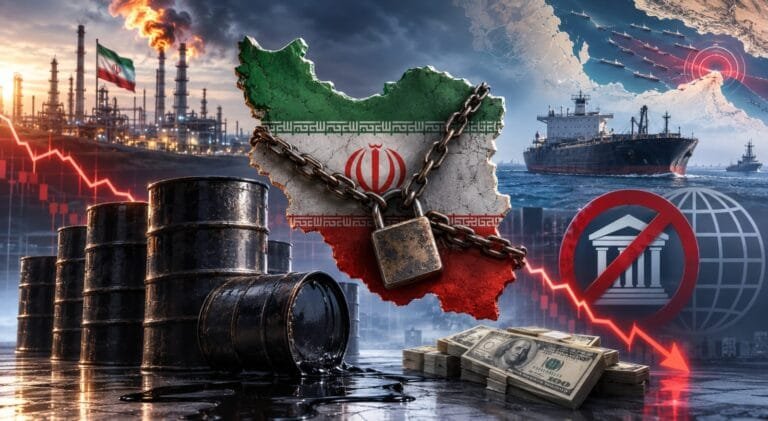
Tehran, Iran – Since 1979, Iran has been subjected to a long history of Western sanctions, beginning with US measures following the hostage crisis. These sanctions gradually expanded to include trade, investment, and the energy sector. Later, they evolved into a multilateral system targeting the nuclear and missile programs, as well as the financial and oil sectors. Over the years, the nature of the sanctions has shifted from targeting specific entities and individuals to targeting entire sectors of the Iranian economy, primarily oil, banking, shipping, and insurance. Consequently, sanctions have become a major factor influencing growth, investment, the exchange rate, and inflation within Iran.
1979–1994: The beginning with asset freezes and trade isolation.
The United States began imposing sanctions on Iran after the Islamic Revolution and the 1979 hostage crisis. These measures included freezing Iranian assets and imposing restrictions on trade and investment. During this initial phase, the impact of the sanctions remained relatively limited compared to later stages. Iran had not yet become as isolated from the global financial and trade system as it did after 2010.
1995–2005: Oil enters a cycle of pressure
US sanctions expanded in the mid-1990s, particularly targeting investment in the oil and gas sectors.
Washington sought to limit Iran’s ability to attract foreign investment and technology to its energy sector. However, Tehran maintained its capacity to export oil and engage with international markets during this period. Meanwhile, the Iranian economy remained heavily reliant on energy revenues. Consequently, the oil sector became the primary vulnerability that sanctions would later target.
2006–2010: Sanctions take on an international dimension
The year 2006 marked a turning point with the transfer of sanctions from the US framework to the UN Security Council, against the backdrop of Iran’s nuclear program. The UN issued a series of resolutions between 2006 and 2010, imposing restrictions on the transfer of technology and equipment related to Iran’s nuclear and missile programs. These resolutions also included financial and travel restrictions, as well as asset freezes, targeting Iranian individuals and entities. With Security Council Resolution 1929 in 2010, international pressure intensified. Simultaneously, the restrictions began to directly impact Iran’s economic and financial sectors.
2011–2013: The most severe economic blow before the nuclear agreement
Sanctions reached a new stage during this period with the combined pressure on oil exports, the banking system, and international trade. The disconnection of Iranian banks from the SWIFT network in 2012, along with the European embargo on Iranian oil, were among the most significant measures that severely impacted Tehran’s ability to access foreign currency and finance trade. The decline in oil exports and foreign revenues put considerable pressure on the value of the rial, while the cost of imports rose and inflation increased. The International Monetary Fund (IMF) indicates that the Iranian economy contracted sharply during this period. An IMF study estimated that the economy shrank by approximately 9% in 2012/2013 following the tightening of trade and financial sanctions in late 2011. Economic studies have shown that the sanctions directly affected investment, industrial production, and trade flows. Therefore, their impact was not limited to the oil sector.
Oil: The Most Sensitive Issue
The oil sector was a focal point of economic pressure on Iran due to its role in generating foreign currency and financing the budget. With the tightening of sanctions, Iran’s ability to sell oil and access its revenues through normal channels diminished. This impacted the currency exchange rate, government spending, and imports, leading to a spillover of the sanctions’ effects from the energy sector into the broader domestic economy. Consequently, the cost of goods, equipment, and raw materials increased, and companies’ access to external financing declined.
2013–2017: The nuclear agreement and the détente phase
Economic pressures began to ease gradually with the diplomatic process that culminated in the 2015 nuclear agreement. In January 2016, the agreement went into effect, and a range of international and European nuclear sanctions were lifted. This allowed Iran to increase its oil exports and restore some of its external economic and financial ties. The Iranian economy experienced a strong recovery following the lifting of nuclear sanctions, with the International Monetary Fund noting that increased oil production and exports were a key driver of this economic rebound. Furthermore, inflation fell to single digits, and the exchange rate stabilized significantly.
2018–2020: The return of “maximum pressure”
2018 marked a turning point following the United States’ withdrawal from the nuclear agreement and the reimposition of sanctions. The “maximum pressure” policy targeted oil exports, the banking sector, shipping, metals, and petrochemicals. Washington also employed secondary sanctions to pressure foreign companies and banks dealing with Iran. The International Monetary Fund (IMF) predicted at the time that the reimposition of US sanctions would lead to a decline in Iranian oil production and exports. Consequently, this impacted growth prospects in the region. US data indicates that Iranian oil exports experienced a significant drop during this period. Simultaneously, the economy entered a new recession, and inflation rose.
2020–2024: Iran adapts to sanctions
As sanctions persisted, Iran began expanding alternative trade channels and relying more heavily on Asian markets, particularly China. Trade and financial networks developed to circumvent the restrictions. The use of intermediaries, barter, and complex shipping arrangements increased, helping Iran maintain a portion of its oil exports despite the sanctions. The World Bank notes that the Iranian economy managed to achieve growth for several consecutive years despite the ongoing sanctions, primarily driven by the recovery of the oil sector.
2025.. The return of international sanctions
2025 saw the return of a significant portion of the international sanctions regime against Iran. The “snapback” mechanism was reactivated, reinstating a range of sanctions stipulated in previous UN Security Council resolutions, including restrictions related to arms, missiles, and nuclear activities, as well as asset freezes and travel bans on specific individuals and entities. Simultaneously, the United States continued to target Iranian oil and shipping networks and intermediaries. Oil market assessments and analyses indicated that the new sanctions did not necessarily halt Iranian exports. China remained a major outlet for Iranian oil, and some Chinese refineries benefited from purchasing Iranian crude at discounted prices.
2026… Sanctions enter a different phase
The year 2026 arrives under circumstances unlike any before, as economic sanctions intertwine with war, military unrest, and the risks associated with navigation in the Gulf and the Strait of Hormuz. In August 2026, the United States announced its readiness to impose what it described as unprecedented economic measures against Iran. This coincided with Washington’s declaration of its ability to maintain the naval blockade indefinitely. The decline in shipping traffic through the Strait of Hormuz has added a new layer of economic pressure. Historically, approximately one-fifth of the world’s traded oil and liquefied natural gas supplies pass through the strait. Simultaneously, shipping traffic through the strait has decreased significantly during the current crisis.
Four decades of sanctions… what has changed in the Iranian economy?
The sanctions have led to profound changes in the Iranian economy, most notably a decline in foreign investment, increased trade costs, weakened international banking relations, currency devaluation, rising inflation, and difficulty accessing technology, equipment, and external financing. However, in recent years, Iran has developed a greater capacity to adapt to the sanctions. This has been achieved through expanding trade with China and other Asian countries, developing alternative financial and trade networks, and adopting different methods for selling and transporting oil.
Sanctions and oil: the most obvious link
The relationship between sanctions and economic performance is most evident in the oil sector. When sanctions were eased following the nuclear agreement, oil production and exports surged, and the Iranian economy experienced a strong recovery. However, when US sanctions were reimposed in 2018, production and exports declined, and the economy entered a new recession. This experience underscores that Iran’s access to oil markets and foreign currency remains a crucial determinant of its economic performance.
From sanctions to a parallel economy
The sanctions did not completely isolate Iran, but they did push it to build a more diversified economy. China became a major partner in the oil trade. Networks of intermediaries, shipping, and indirect financing also helped sustain a portion of Iranian trade. Thus, the impact of the sanctions gradually shifted from attempting to halt Iranian economic activity to increasing its cost and reducing its capacity to achieve the growth and investment rates it would have achieved in a normal trading and financial environment.