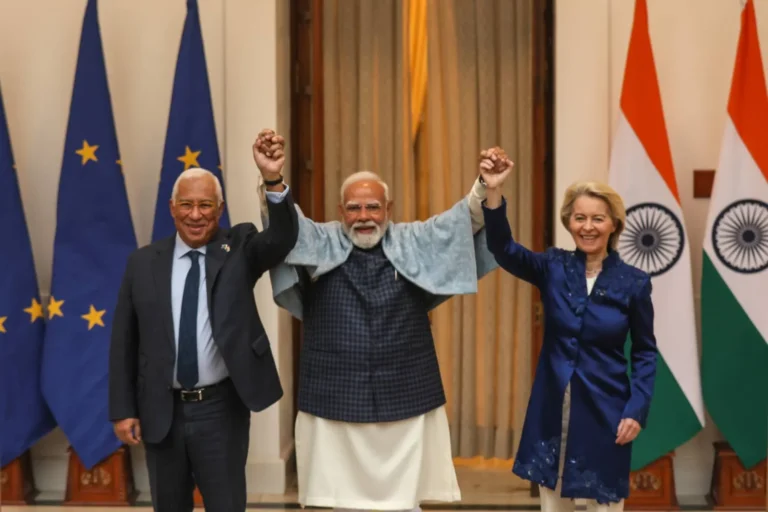
New Delhi, India – In a move described as a “seismic shift in global trade,” Indian Prime Minister Narendra Modi and European Commission President Ursula von der Leyen announced on Tuesday the formal conclusion of negotiations for a comprehensive free trade agreement between India and the European Union. This brings to an end nearly 20 years of stalled negotiations.
A trading zone for two billion people
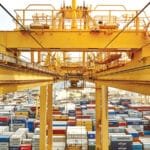
This agreement, dubbed the “mother of all deals,” creates a free trade area encompassing nearly two billion people, covering 25% of global GDP and a third of international trade. This strategic move serves as a shield for both parties against the volatile US trade policies under the Trump administration, which imposed punitive tariffs of up to 50% on some Asian imports last August.
Key provisions of the agreement and sectoral gains
The agreement includes a historic and gradual reduction of tariffs on more than 90% of traded goods, with the following details:
Automotive sector: Indian tariffs reduced from 110% to just 10% (within a quota of 250,000 vehicles annually). This opens the door for European manufacturing giants such as Mercedes and Volkswagen.
Beverages and food: Tariffs on European wine have been reduced from 150% to 20%, and tariffs on beer have been reduced from 110% to 50%, with tariffs on “pasta, chocolate, and olive oil” being completely abolished.
Indian exports: The EU has eliminated tariffs on 99% of Indian exports. This will give a huge boost to the textiles, leather, footwear, and jewelry sectors. Furthermore, Indian exports to the EU are expected to increase by $50 billion by 2031.
Medicines and chemicals: Eliminating customs duties on the vast majority of these products, which strengthens India’s position as the “pharmacy of the world” in the European market.
Geopolitics: Diversifying partners away from Washington and Beijing
The agreement was not merely economic; it represented a significant geopolitical shift. The European Union seeks to reduce its dependence on China and the United States, while India attempts to secure alternative markets to offset losses incurred due to US tariffs. Simultaneously, the two sides announced a new “security and defense partnership” aimed at coordinating efforts in defense industries and maritime security. This move indicates India’s desire to lessen its reliance on Russian weaponry and Europe’s ambition to bolster its strategic independence from Washington.
What’s next?
The agreement will now undergo a “legal review” process that could take up to six months before being submitted to the European Parliament for final ratification. This deal comes just days after the European Union concluded a similar agreement with the Latin American trade bloc Mercosur. This underscores Brussels’ adoption of a “geopolitical pragmatism” strategy to address the unstable global order.