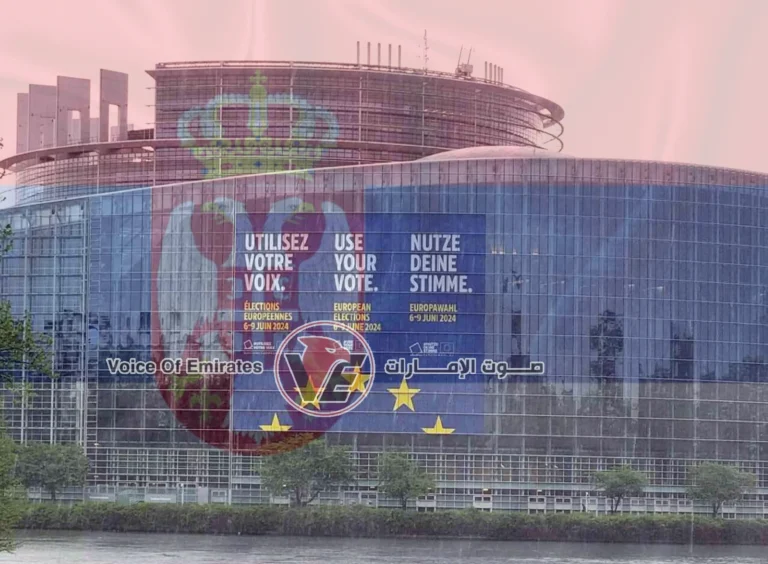
Exclusive, Voice of the Emirates – While the European Parliament is bogged down in the details of 531 amendments to the draft report on Serbia,
Brussels seems to have finally decided to move beyond the cold language of “diplomatic concern.”
It is now putting its finger on the most sensitive nerve of Aleksandar Vučić’s regime: money.
The Green Party’s explicit demand to suspend EU funds allocated to Belgrade is not merely a political maneuver.
It signals a new phase that could end the era of “walking a tightrope” that Serbia has mastered for years.
The missing “Euro” weapon
For years, Serbia has benefited from its “perpetual candidate” status, receiving billions of euros from pre-accession funds (IPA).
Yet, it has maintained its freedom of movement within the orbits of Moscow and Beijing.
But recent developments suggest that the patience of the “big players” has run out.
When the Greens, backed by powerful behind-the-scenes factions,
demand aid cuts in response to “police violence” and the suppression of protests,
they understand that this is the only weapon capable of destabilizing the government.
This government relies on these funds to finance infrastructure projects and secure political loyalty.
Suspending aid doesn’t just mean budgetary figures; it means halting the “European engine”
that grants the Serbian regime its economic legitimacy domestically.
Belgrade understands that turning to Russia or China might provide “weapons or in-kind investments,”
but it won’t fill the void left by the withdrawal of the European “euro.”
Novi Sad… the straw that broke the camel’s back of silence
The issue is no longer simply about “aligning foreign policy” or “sanctions against Russia”; it has become a structural crisis of confidence.
The Novi Sad tragedy and the rampant corruption pointed at in the construction sector have
become “fuel” for the opposition within the European Parliament.
The MPs’ insistence on mentioning specific names and criticizing “illegal” appointments in broadcasting bodies
and civil society reveals that Brussels has begun to dismantle the “network of influence” that protects the power in Belgrade.
Far right: Vucic’s last “lawyer”
The strange paradox in the European Parliament lies in the identity of Serbia’s “defenders.”
While the ruling coalition calls for democracy and the rule of law, far-right groups like “Europe of Sovereign Nations”
and the Hungarian Fidesz party stand as a bulwark defending “Serbian sovereignty.”
This unusual alliance puts Vucic in an awkward position; he finds himself supported by “disreputable” elements within the EU.
This further isolates his country from the “renewing Europe” movement and the social democrats who hold the real power.
Upcoming scenarios: shaky stability or bitter submission
Today, Serbia finds itself facing two equally bitter choices:
1. Complying with Brussels: This would mean imposing sanctions on Russia and dismantling the politically protected corruption networks.
This could potentially lead to a fracturing of the regime’s internal front.
2- Political stubbornness: Continuing with the current approach and risking a “freeze on funds” decision.
This will inevitably lead to a crippling economic crisis that could unleash a wave of protests in Serbia that will spare no one.
The revised Tonino Piccola report is not just a bureaucratic document that Strasbourg will vote on next July;
it is a “final warning” to a system that thrives on contradictions.
If financial aid dries up, Belgrade’s room for maneuver will collapse with it. Vucic will then find nothing in Moscow
or Beijing to compensate him for the “European paradise” that has begun to close its doors to him.