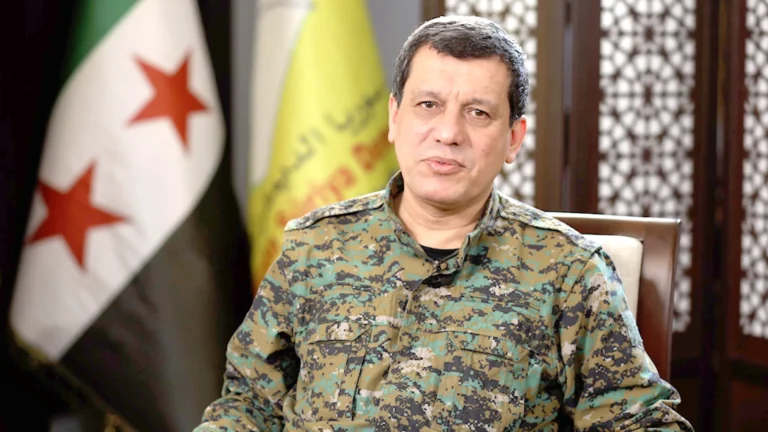
Damascus, Syria – A high-ranking source in the Autonomous Administration of North and East Syria revealed on Saturday evening that the commander of the Syrian Democratic Forces (QASAD), Mazloum Abdi,
had arrived in Damascus to hold direct talks with officials of the Syrian transitional government.
This negotiating track has been described as having entered a “critical phase”;
the visit aims to transform theoretical understandings into practical steps
that will end the state of division that has plagued the country for years.
Military axis: One army with a diverse composition
Regarding the field details, Yasser Suleiman, spokesman for the self-administration delegation, revealed
that the anticipated agreement is based on the principle of having only one army for the Syrian state.
Accordingly, it was agreed to integrate the SDF into the military establishment with a diverse composition,
with a joint military committee tasked with formulating the implementation mechanisms.
This is what Solomon summarized by saying: “There cannot be two armies in one country.”
Resources and crossings
Furthermore, the agreement extended to economic sovereignty issues, where it was agreed
that oil and natural resource revenues would belong to all Syrians and be spent through official institutions.
Despite the complexity of the border issue, there is a trend towards
joint management of the crossings with Iraq and Turkey.
This is consistent with the centralized state system while preserving
the rights of the staff currently working in those locations.
Administrative decentralization
On the other hand, a significant convergence of views emerged regarding
the adoption of an administrative “decentralization” system.
Especially since both parties are looking to activate Law 107 after amending it,
which would allow residents to directly elect their local officials and governors.
Given the continued lack of trust, the self-administration delegation
demanded the necessity of international guarantees.
This is to implement the agreement of March 10, 2025, to ensure
that these understandings are not reversed.
Summary of the situation and field tensions
Abdi’s visit to Damascus comes as a last-ditch effort to turn the page
on the military and administrative division.
However, this path still faces challenges on the ground, especially with
the recent tensions in the Aleppo neighborhoods (Sheikh Maqsoud and Ashrafieh).
Therefore, the success of this agreement remains contingent on the ability of
both parties to overcome security incidents and prioritize a comprehensive political solution.
This will be determined by the schedule of meetings in the capital in the coming hours.