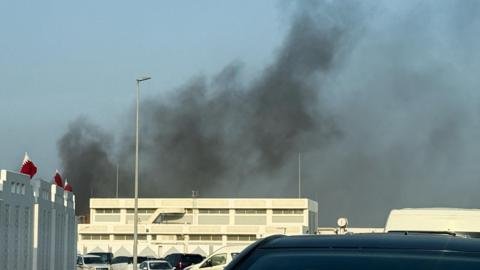
Cairo, Egypt – The Israeli bombardment that targeted Doha was not a passing attack. Instead, it revealed a new stage of escalation in the region. For the first time, the flames of war have reached the heart of the Qatari capital. This development opens the door to existential questions about the future of regional security and international balances.
Six Dead, Including Senior Leaders
The attack resulted in the killing of six people, five of them senior Hamas leaders who were visiting Doha. Additionally, a Qatari security officer was killed. Several members of Qatar’s internal security forces were also injured, though no precise number was announced. In terms of material damage, the capital witnessed the massive destruction of a residential building. It was believed to have housed a political office of the movement, amid a state of shock that gripped the area.
A Strike Laden with Dangerous Political Messages
Striking the Qatari capital cannot be read in isolation from the broader political landscape. Qatar, which has played the role of mediator in numerous regional files, suddenly found itself a direct target. This shift could redraw the map of alliances. The attack came at a critical moment when international pressure is mounting to end the war on Gaza.
The Arabs United as One
The attack was met with a flood of Arab condemnations. The Qatari Foreign Ministry issued a strongly worded statement, describing the bombing as a “cowardly act.” UAE, Egypt, Jordan, Kuwait, Algeria, Morocco, and Tunisia all expressed their full solidarity with Doha. They stressed that targeting Arab capitals constitutes a direct threat to national security. The Arab League called for urgent international action to stop the assaults and protect the sovereignty of states. Notably, this time Arab statements carried a tone of greater unity and firmness. This reflects a collective awareness of the grave risk of the region sliding into broader chaos.
International Division and a Confused Security Council
The United States expressed its “deep concern” but limited its response to urging restraint. Meanwhile, the European Union explicitly condemned the military operation inside Qatar. Russia and China, meanwhile, held Israel responsible for expanding the scope of the war. They called for an emergency Security Council session. This divergence in positions reflects the depth of international division. It underscores that the attack was not a passing event, but a pivotal point in the conflict.
Media Between Justification and Exposure
The media was not absent from the battlefield. Some Western platforms attempted to justify the attack as a “preemptive strike” against Hamas leaders. In contrast, Arab and independent international media focused on the blatant violation of Qatari sovereignty. They warned that Israeli escalation threatens to set the entire region ablaze.
The Gulf in the Eye of the Storm
Targeting Doha does not only mean expanding the fire to include a new capital. It also confirms that the entire region now sits on a hot plate. Lebanon and Syria have recently been subjected to similar attacks. Today it is Qatar—tomorrow, another capital may be in the crosshairs. The equation is clear: no one is safe, and the scene is heading toward greater complexity. If the international community does not act quickly to stop this bleeding, the situation may worsen.