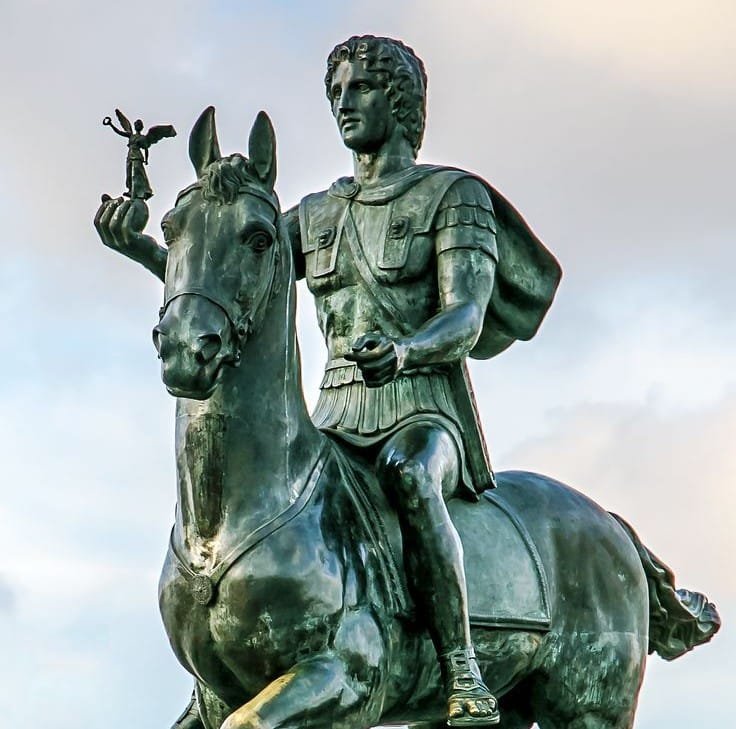
London, United Kingdom – A recently published book about Alexander the Great has reopened one of the most controversial historical files. It presents a different perspective on the Macedonian leader, who is considered one of the most famous military commanders in history. Moreover, the book boldly questions whether Alexander was a conquering hero who changed the course of history or a bloody leader who left behind ruined cities and thousands of victims.
A Critical Review of Historical Sources
This new work is based on a comprehensive review of a large number of ancient historical sources and modern studies. It is a serious attempt to separate historical facts and events from the mythical image that has surrounded Alexander’s persona over the centuries. Furthermore, the book’s author argues that traditional narratives have heavily focused on his military genius and the vast expansion of his empire. Meanwhile, these narratives have marginalized or downplayed the massive destruction and heavy human casualties that accompanied his military campaigns in Asia and the Middle East.
Milestones of Glory and a Sudden End
The book covers the most prominent milestones of Alexander’s life, starting from his assumption of power in Macedonia in 336 BC, through his crushing victories over the Persian Empire, and his arrival in Egypt, Mesopotamia, and reaching the borders of India. The book concludes this epic journey with his sudden and mysterious death in Babylon in 323 BC, while he was still thirty-two years old, leaving behind a sprawling empire that quickly disintegrated and was fought over by his generals after his departure.
Academic Division and Balanced Evaluation
The publication notes that Alexander’s character has always been a subject of sharp division among historians. While one group sees him as an exceptional leader who contributed to spreading Hellenistic culture and promoting civilizational exchange between East and West, another group holds him directly responsible for bloody wars and systematic destruction, asserting that his military successes came at a steep human and civilizational cost.
The release of the book has sparked widespread interest in academic and cultural circles. It has reignited the debate on how to read historical figures away from absolute glorification or complete condemnation. In addition, this trend reflects a growing path in modern historical studies to re-examine major figures based on archaeological evidence and diverse sources. This approach opens the door to a more objective and balanced understanding of a legacy that continues to stir controversy after more than two millennia.