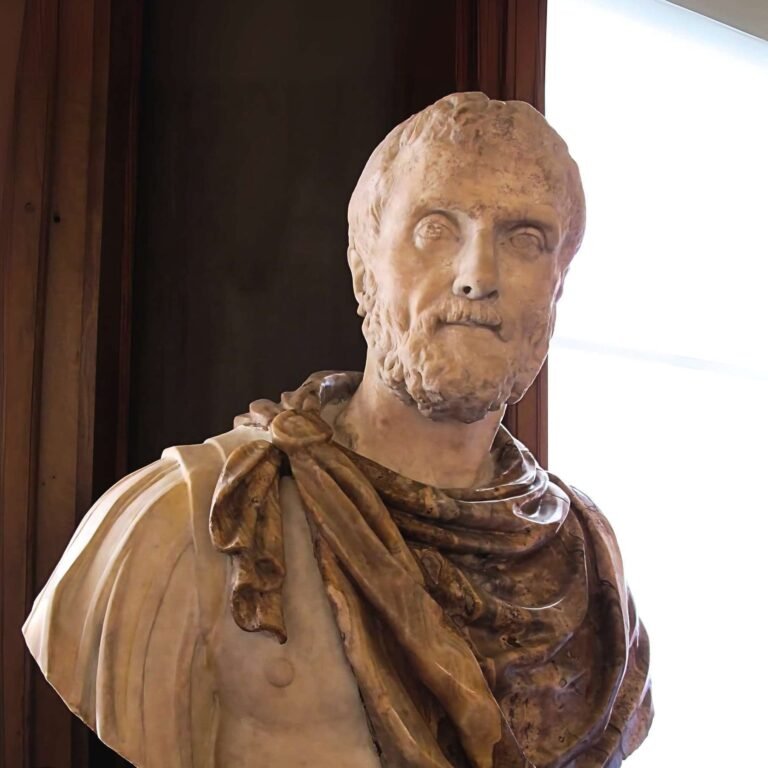
Rome, Italy | In the pages of ancient Roman history, an exceptional figure stands out, challenging the political and class norms of his era. He is Emperor Macrinus, the man who did not descend from traditional aristocratic families, nor was he of the lineage of the Roman Senate. Instead, he hailed from the region of Mauretania Caesariensis, known today as the city of Cherchell, Algeria. His ascent to the throne was an unprecedented event in Roman history; he transitioned from an ambitious administrative official to the ruler of the world’s most powerful empire at the time.
Born in 164 AD, Macrinus paved his way through Roman state institutions with remarkable legal and administrative competence. He ascended through the ranks to become the right-hand man of Emperor Caracalla, granting him significant influence within the corridors of power. With Caracalla’s assassination in 217 AD, Macrinus found himself at the heart of a power struggle, declaring himself emperor during a phase when the empire was suffering from stifling political and military instability.
Challenges of Governance and Austerity Policies
In a related context, Emperor Macrinus faced a heavy legacy of financial crises. He adopted strict austerity policies to curb increasing military expenditures. However, these policies, which aimed to preserve the state treasury, became a double-edged sword, sparking massive resentment among military leaders who were accustomed to generous grants and bonuses. This resentment was the first seed of his opposition.
Furthermore, his short reign, which lasted nearly a year, was filled with security challenges. With the emergence of new rivals backed by influential military forces, Macrinus’s throne began to shake. In 218 AD, the end came in a decisive battle against the forces of the young Emperor Elagabalus. Macrinus was defeated and captured while attempting to flee, closing one of the shortest and most intriguing periods in Roman history.
Historical Legacy: A Symbol of Roman Diversity
On another note, historians believe that the story of Emperor Macrinus is not just the story of a ruler who lost his power. It is an embodiment of a historical phase characterized by the expansion of the empire and the diversity of its population. The rise of a figure from North Africa to the peak of power was evidence that the Roman Empire was not the exclusive domain of Rome or Italy, but a global entity that absorbed talents from all its distant regions.
In conclusion, Macrinus remains a pivotal figure who intrigues researchers. He represents that gap between the world of traditional aristocracy and the emerging era of “barracks emperors.” Despite the short duration of his reign, his biography remains a living witness that human ambition can break the boundaries of geography and social class to reach the throne, if only for a while.