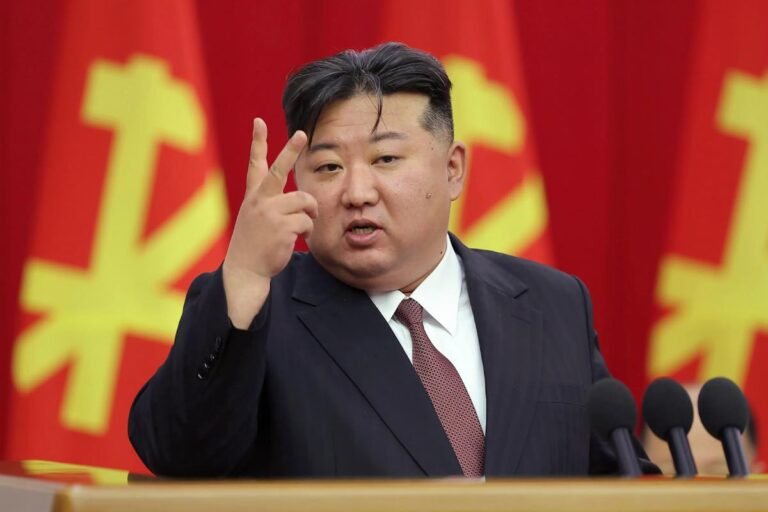
Pyongyang, North Korea – In a new escalation reflecting Pyongyang’s determination to bolster its military capabilities, North Korean leader Kim Jong Un inspected a state-of-the-art nuclear materials production facility that recently became operational, the North’s official Korean Central News Agency (KCNA) reported Thursday. During his visit, Kim urged officials and scientists to achieve a massive and bold expansion of the country’s nuclear arsenal in response to growing security challenges.
Doubling the production of military materials and relying on technology
North Korean leader Kim Jong Un stated that his country’s capacity to produce fissile nuclear material for deadly weapons has more than doubled in the past five years.
Based on this production surge, Kim issued strict instructions to officials to increase current and future production rates. He also emphasized achieving the long-term strategic goals set by the supreme leadership, according to Reuters.
The Central News Agency reported that Kim was briefed during the visit on new production processes that rely entirely on more advanced and modern domestic technology. Images released by state media also showed Kim walking among long rows of cylindrical equipment inside the facility. Military analysts said this clearly indicated advanced centrifuges for uranium enrichment. They also suggested the site is located within the main nuclear complex at Yongbyon. Kim Jong Un stated, “This nuclear expansion is necessary given the escalating security threats and the protracted confrontation with our most ruthless enemies.”
High alert in Seoul and political dimensions of the nuclear maneuver
On the other hand, a senior official in South Korea’s Joint Chiefs of Staff commented during an urgent press conference held in Seoul, saying that the nuclear facility revealed by North Korea on Thursday is a site dedicated to enriching high-purity uranium for military purposes.
Political analysts, for their part, asserted that Kim’s surprise visit and the magnitude of the announcement were primarily aimed at strengthening North Korea’s negotiating position and imposing its conditions as a fait accompli before any potential diplomatic engagement with Western powers, as well as justifying the acceleration of its nuclear program to the public.
These developments come at a time when international peace institutes estimate that North Korea currently possesses approximately 50 nuclear warheads. In contrast, Pyongyang maintains a policy of strategic ambiguity and has never officially disclosed the true size of its destructive arsenal.