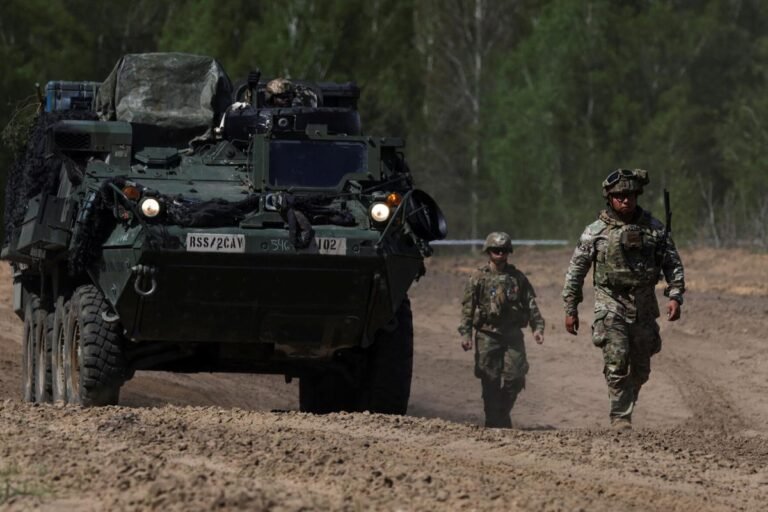
The US President, Donald Trump, announced a sudden military decision to deploy an additional 5,000 American troops to Polish territory, in a new strategic move to reshape the map of military influence in the Eastern European region.
This prominent announcement came through a brief post published by the US President on his personal social media platform, “TruthSocial,” where he clearly wrote: “The United States will send 5,000 additional troops to Poland.”
Strengthening Washington’s Allies and Absolute Geopolitical and Field Support for “Nawrocki”
Observers and politicians linked the timing of this decision to Trump’s strong desire to provide absolute geopolitical and field support to the Polish government, taking into account the close and special alliance that binds the US President with the new Polish President, Karol Nawrocki, who enjoys direct backing and support from the Trump administration to enhance Warsaw’s status as a key and reliable ally for Washington on the European continent.
Ambiguity Surrounding the Nature and Source of the Forces and Questions on the Pentagon’s Role
Despite the massive security dimensions of the new American military deployment, military and diplomatic circles in Washington and Warsaw are still witnessing a state of ambiguity and confusion regarding the details of these forces.
The US Department of Defense, “The Pentagon,” has not yet clarified whether Trump’s statements mean the resumption of the plan to deploy 4,000 US troops to Poland, which was previously postponed for logistical and funding reasons, or whether the decision represents an alternative plan for repositioning and a partial transfer of US forces previously stationed in military bases within Germany and redirecting them toward the Polish front.
Security circles in the North Atlantic Treaty Organization (NATO) are anticipating the issuance of a detailed statement from the White House to determine the timeline and logistical tasks assigned to these reinforcements, which would deepen joint defense lines in the face of current regional challenges.