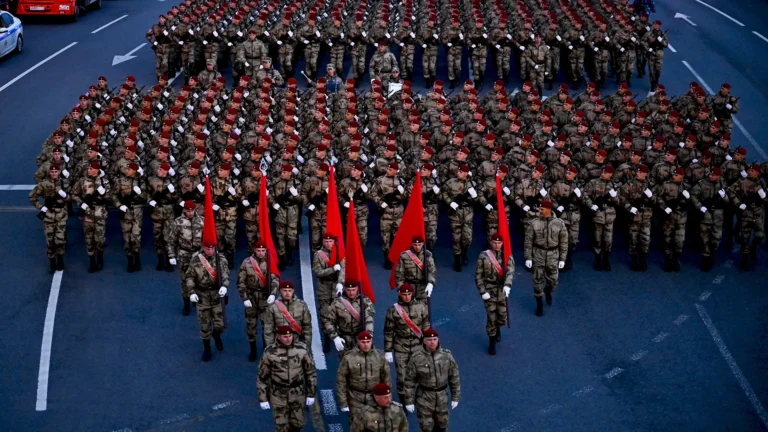
Berlin, Germany – German authorities in Berlin have announced a ban on displaying or exhibiting a number of Russian military symbols and emblems during Victory Day celebrations, which commemorate the Soviet Union’s victory over Nazi Germany in World War II. This comes amid heightened security measures and concerns that the occasion could be exploited for political purposes.
Berlin police confirmed that the ban includes the display of old Russian and Soviet flags. It also covers military symbols associated with the Russo-Ukrainian War, particularly around Soviet-era monuments. Furthermore, the ban applies to locations where large crowds gather during the annual commemorations.
Authorities explained that these measures are aimed at “maintaining public order and preventing any political tensions or provocations.” This comes amid the ongoing war in Ukraine and the sharp division within Europe regarding Moscow. They also indicated that police would be heavily deployed in several areas of the capital to monitor compliance with the new regulations.
The decision has sparked controversy within political and human rights circles in Germany. Some consider it a necessary step to prevent the event from being used to support Russian military operations. Others, however, believe the ban could be interpreted as a restriction on freedom of expression and assembly.
Germany annually holds events commemorating Victory Day, particularly in the capital, Berlin, which boasts numerous Soviet-era monuments. These events are attended by citizens of Russian and Ukrainian descent, along with activists and various political groups.
This German initiative comes at a time of escalating tensions between Moscow and European capitals. This coincides with the continuation of Western sanctions and military support for Ukraine, leading to heightened security and political scrutiny of historical events with a Russian character in several European countries.