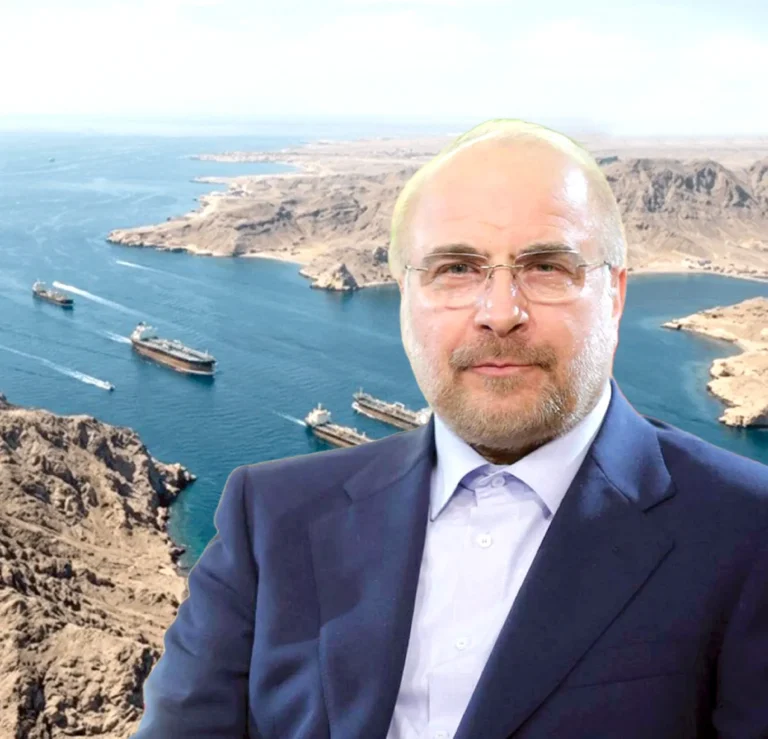
Tehran, Iran – Iranian Parliament Speaker Mohammad Bagher Ghalibaf asserted that talk of a complete and comprehensive ceasefire is illogical as long as the agreements continue to be violated through the imposition of a naval blockade on the country.
Ghalibaf, in statements carried by the Iraqi News Agency (INA),
clarified that Iran’s position regarding current developments remains firm.
He also emphasized that stability on the ground is inseparable from freedom of navigation and trade.
He affirmed that any agreement that does not guarantee the lifting of maritime
restrictions will remain incomplete and practically unenforceable.
Linking the opening of the Strait of Hormuz to lifting the blockade
The Speaker of the Iranian Parliament explicitly stated that reopening the Strait of Hormuz
to international shipping is “out of the question” as long as the US naval blockade continues.
He emphasized that the Strait of Hormuz is a strategic waterway and that its continued
closure is a direct consequence of US policies aimed at economically strangling Tehran.
He further asserted that navigation in the region is intrinsically linked to respecting Iran’s right to free
and unhindered access to international waters without any military threats or impediments.
Criticism of US violations of the truce
The Speaker of the Iranian Parliament criticized the US approach to the ceasefire,
deeming the naval blockade a “blatant violation” of any efforts aimed at de-escalation.
He explained that Iran views these actions as an attempt to impose
a new reality under the threat of force, which Tehran categorically rejects.
He also noted that the continued military presence and restrictions
on commercial vessels undermine the chances of reaching a lasting settlement.
He stated that this renders any declaration of a truce merely a symbolic gesture
that fails to address the core of the crisis, which he described as an “economic war.”
The strategic position on water security
The Iranian official emphasized that his country possesses all the legal and practical means to protect its sovereignty and territorial waters.
He also explained that its decisions regarding vital waterways stem from its assessment of the threats to its national security.
Qalibaf asserted that the ball is now in the US court to lift the sanctions and create the conditions for the resumption of normal navigation.
However, he warned that the policy of pressure will not succeed in extracting political concessions,
but will instead lead to further complications in the regional landscape
and exacerbate the situation in international maritime routes upon which the global economy depends.