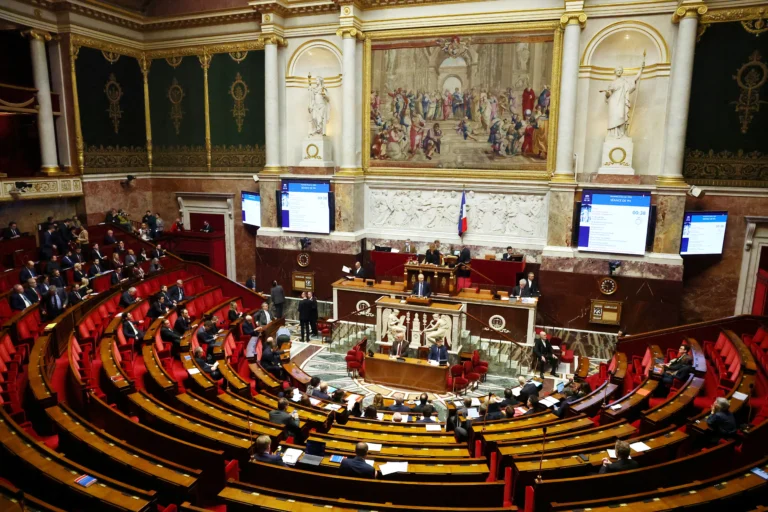
Paris, France – The French government has successfully survived the first of two no-confidence motions in parliament,
marking a significant step towards passing the 2026 budget after weeks of political wrangling and divisions within the National Assembly.
The vote showed that 260 deputies supported the no-confidence motion put forward
by the far-left party La France Insoumise (France Unbowed), falling short of the 289 votes needed to bring down the government.
This allowed the government to overcome its first major parliamentary hurdle in the process of adopting the new budget.
Sharp division within parliament
This vote is seen as an indicator of the government’s ability to withstand mounting political pressure, particularly given the sharp divisions within parliament
between left-wing and right-wing blocs and the difficulty in building a broad consensus on proposed economic and fiscal policies.
Later that same day, parliament is scheduled to consider a second motion of no confidence, tabled by the far-right National Rally party.
Parliamentary projections suggest the government will also survive this motion, paving the way for it to proceed with the 2026 budget.
Tensions within Parliament
The French government is striving to pass the budget as quickly as possible to avoid financial uncertainty
and ensure the continued functioning of state institutions,
particularly given the current economic challenges, rising living costs, and pressures related to the budget deficit and public debt.
Observers believe that overcoming the two no-confidence motions, if successful, would give the government a temporary political boost,
but it would not end the tension within parliament, where the opposition, in all its forms,
continues to oppose the government’s economic and social policies.
These developments reflect the ongoing complexity of the political landscape in France,
where the government faces a constant challenge in passing essential legislation without a comfortable parliamentary majority.
This makes every vote a crucial test of its survival and its ability to implement its reform program in the coming period.