Sign In
Wednesday, Jun 24, 2026
  • العربية
Top Header VOE Logo Header Dark Mode VOE Logo
  • Latest
  • Emirates
  • News
    • Gulf Countries
    • Arab Countries
    • World
  • Politics
    • Analysis
    • Interviews
    • Reports and investigations
  • Business
    • Companies
    • Real Estate
    • Stock Market
    • Green Energy
    • Oil And Gas
    • Bitcoin
    • Business Reports
  • Science and Tech
    • AI
    • Electric Vehicles
    • Space and Mars
  • Sport
    • World Cup 2026
  • Society
  • Health
  • Lifestyle
  • Travel and Hotels
Reading: Voice of the Emirates reveals: How did the Muslim Brotherhood use religion to destabilize Arab countries?
Share
Latest
England Clashes with Ghana in 2026 World Cup: A Confrontation Between European Experience and African Ambition
Empress Josephine: From Partner in Napoleon’s Glory to a Lonely End in the Shadows
Ronaldo: I was looking forward to scoring in the 2026 World Cup.. and we still have a lot to offer
Libya Tightens Border Security and Imposes New Entry Restrictions on African Nationalities
Macron Calls for a Comprehensive Truce in Lebanon Ensuring Israeli Withdrawal
Font ResizerAa
Voice Of EmiratesVoice Of Emirates
  • العربية
  • Latest News
Search
  • News
    • Emirates
    • Gulf Countries
    • Arab Countries
    • World
  • Politics
    • Analysis
    • Interviews
    • Reports and investigations
  • Business
    • Companies
    • Real Estate
    • Stock Market
    • Green Energy
    • Oil And Gas
    • Bitcoin
    • Business Reports
  • Science and Tech
    • AI
    • Electric Vehicles
    • Space and Mars
  • Lifestyle
  • Society
  • Sport
    • World Cup 2026
  • Health
  • Travel and Hotels
Have an existing account? Sign In
Follow US
All rights reserved © Voice of Emirates - News service from Our Media Group
Arab CountriesNews

Voice of the Emirates reveals: How did the Muslim Brotherhood use religion to destabilize Arab countries?

The Muslim Brotherhood and the dangers of religiously based discourse

مدحت الشيخ
Last updated: 23/12/2025 6:04 pm
Medhat Elsheikh
مدحت الشيخ
ByMedhat Elsheikh
News Editor
Medhat El-Sheikh, editor-in-chief of the Voice of Emirates News Agency office in Cairo, is a seasoned Egyptian journalist with extensive experience both within Egypt and abroad....
- News Editor
6 months ago
Share
6 Min Read
Voice of the Emirates reveals: How did the Muslim Brotherhood use religion to destabilize Arab countries?
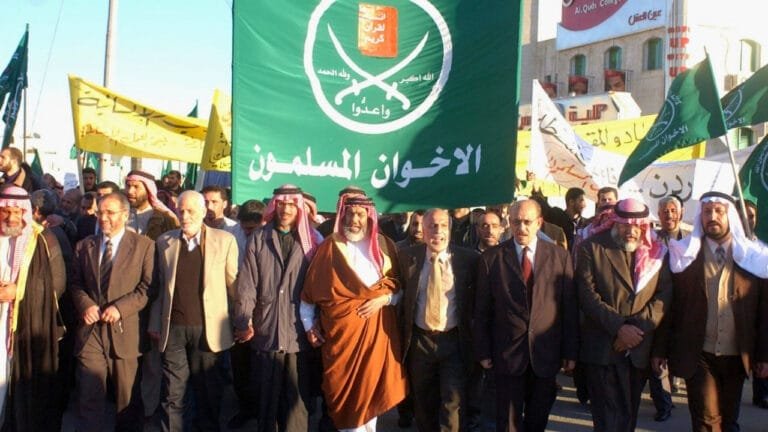
The Muslim Brotherhood (Photo/Archive)
SHARE
Highlights
  • First: Transforming religion from a system of values ​​into a tool of conflict
  • Second: Organization before homeland… always
  • Third: The duplicity of discourse… the Brotherhood’s most dangerous weapon
  • Fourth: The pragmatic relationship with the West
  • Fifth: Chaos as an ideal environment for empowerment
  • Sixth: The link between the Muslim Brotherhood and extremist organizations
  • Seventh: Why is the group classified as a security threat?
  • Conclusion: Religion is innocent of the project of chaos.

Voice of Emirates – Since its inception, the Muslim Brotherhood has not been merely a religious or missionary movement as it promoted itself, but rather represented an early model of an ideological organization that employs religion as a political tool, and reshapes it to serve a long-term authoritarian project based on penetrating the state from within rather than building it, and on exhausting society rather than uniting it.

First: Transforming religion from a system of values ​​into a tool of conflict

The most dangerous thing the group did was strip religion of its ethical and humanistic context, transforming it into a sharp, mobilizing rhetoric used to justify conflict with both the state and society.

In the Brotherhood’s discourse, religion was not a unifying force, but rather a tool for division:

Believer versus “non-practicing.”

An Islamic project versus a “corrupt secular state.”

A “divinely guided” group versus an “oblivious” society.

This logic sowed doubt within the social fabric and created a state of perpetual polarization, making stability impossible, as society becomes subjected to a constant test of faith and political conviction.

Second: Organization before homeland… always

In all Arab experiences, it has become clear that organizational loyalty takes precedence over national affiliation.

The group does not operate as a political party subject to the laws of the state, but rather as a closed organization with:
a pledge of allegiance,
a secret leadership hierarchy, and
directives that transcend national borders.

Herein lies the real danger:
The state is governed by the logic of sovereignty, while the Brotherhood operates according to the logic of an “organizational nation,” making conflict inevitable, because the state does not accept a partner operating within it with a mindset that transcends it.

Third: The duplicity of discourse… the Brotherhood’s most dangerous weapon

The group practiced what could be termed systematic rhetorical deception:

A conciliatory discourse directed abroad, particularly to the West, speaking of democracy and human rights.

And a mobilizing discourse directed internally, inciting against the state, demonizing its institutions, and justifying its overthrow.

This duplicity enabled the group to:
Gain the sympathy of some Western circles.
Use international media platforms to pressure Arab states.
Present itself as a “political victim” while in reality being an active participant in creating chaos.

Fourth: The pragmatic relationship with the West

Contrary to public rhetoric, the Muslim Brotherhood’s relationship with some Western powers was not one of enmity, but rather one of mutual interests.

The West saw the group as:

A disciplined organization with which it could negotiate.

A tool for exerting pressure on national regimes.

A readily available alternative in moments of political collapse.

For its part, the Brotherhood saw the West as:

A political and media umbrella of protection.

A safe haven for its leaders and funding.

A platform for its international reinvention whenever it faced internal pressure.

Fifth: Chaos as an ideal environment for empowerment

The group has never succeeded in a stable environment, but it thrives in:
Economic crises,
Social divisions,
Weak state institutions.

In moments of chaos, it moves quickly:
Riding the wave of popular anger.

Raising slogans of justice and reform.

Then attempting to seize power without a genuine national project.

The result is always the same:
Deepening divisions, paralyzing state institutions, and eroding trust between citizens and the authorities.

Sixth: The link between the Muslim Brotherhood and extremist organizations

Despite attempts to separate them, the underlying ideology remains the same:

A monopoly on religious truth.

A rejection of the modern nation-state.

A justification of violence under the guise of “legitimate necessity.”

Many figures of violence emerged from the ranks of the Muslim Brotherhood, or were steeped in its literature, before moving to more extreme phases.

The difference lay not in the ideology itself, but in the timing and the methods employed.

Seventh: Why is the group classified as a security threat?

Because:

It does not believe in the state except as a temporary phase.

It does not believe in democracy except as a means.

It does not believe in religion except as a cover.

It is a political group cloaked in religion, not a secular group practicing politics, and the difference here is fundamental.

Conclusion: Religion is innocent of the project of chaos.

The Arab experience confirms that religion has never been an obstacle to stability; rather, its political exploitation is at the heart of the crisis.

For decades, the Muslim Brotherhood has used the sanctity of religion to justify a project that rejects the state, intolerant of pluralism, and unwilling to share power.

With the growing awareness of societies, it has become clear that protecting the nation-state is not against religion, but rather a defense of it, safeguarding it from being used as fuel in power struggles.

TAGGED:Arab countriesVoice Of Emirates
SOURCES:Voice Of Emirates
Share This Article
Facebook Whatsapp Whatsapp LinkedIn Telegram Threads Email Copy Link Print
Previous Article US State Department: Iran has executed 1,800 people this year to quell protests US State Department: Iran has executed 1,800 people this year to quell protests
Next Article Former French Chief of Staff issues a warning cry: Islamic extremism threatens our existence Former French Chief of Staff issues a warning cry: Islamic extremism threatens our existence
31°C
Dubai
clear sky
31° _ 31°
78%
5 km/h
Wed
38 °C
Thu
37 °C
Fri
34 °C
Sat
35 °C
Sun
36 °C

Editor's Pick

England Clashes with Ghana in 2026 World Cup: A Confrontation Between European Experience and African Ambition

A highly anticipated football showdown in Boston brings together the legacy of the "Three Lions" and the passion of the…

By
Medhat Elsheikh
3 Min Read
Empress Josephine: From Partner in Napoleon’s Glory to a Lonely End in the Shadows

An exceptional journey of a woman who left her mark on European…

3 Min Read
Ronaldo: I was looking forward to scoring in the 2026 World Cup.. and we still have a lot to offer

Houston, USA – Cristiano Ronaldo, the captain of the Portuguese national team,…

2 Min Read

Trending

Libya Tightens Border Security and Imposes New Entry Restrictions on African Nationalities

Libya border security

2 hours ago

Macron Calls for a Comprehensive Truce in Lebanon Ensuring Israeli Withdrawal

French emphasis on the need for…

2 hours ago

Africa continues to shine.. Ghana forces a draw against England and maintains its chances in the World Cup (video)

Foxborough, USA - Ghana forced a…

2 hours ago

Putin Renews Political Settlement Proposal: Moscow Links Ukraine Negotiations to Previous Istanbul Understandings

A call to resume the diplomatic…

2 hours ago

Ronaldo’s historic night: Portugal thrashes Uzbekistan 5-0 and revives its World Cup hopes (video)

Houston, USA - Portugal achieved a…

2 hours ago

You may also be interested in

NewsWorld

Grossi: Upcoming Talks Between the IAEA and Iran to Resume Nuclear Cooperation

Vienna, Austria – The Director General of the International Atomic Energy Agency (IAEA), Rafael Grossi, announced that the agency intends…

2 Min Read
NewsWorld

China’s Consumer Spending Slowdown Raises Concerns Over Economic Recovery Strength

Beijing, China – Recent economic data has shown a continued slowdown in consumer spending in China, with retail sales recording…

3 Min Read
NewsWorld

Death Toll from Russian Attacks on Ukraine Rises to 9

Kyiv, Ukraine – The death toll from a new wave of Russian strikes targeting several Ukrainian regions on Tuesday has…

3 Min Read
Lebanese statements: Hezbollah's practices affect the state's position in negotiations
Arab CountriesNews

Lebanese Justice Minister: The State Alone is Responsible for Southern Security, and Amnesty is Far from Polarization

Beirut, Lebanon – Recent statements by the Lebanese Minister of Justice indicate a clear and direct shift towards tightening the…

3 Min Read
Top Header VOE Logo Header Dark Mode VOE Logo
  • About Us
  • Contact us
  • Advertise on Voice Of Emirates
  • Privacy Policy
Reading: Voice of the Emirates reveals: How did the Muslim Brotherhood use religion to destabilize Arab countries?
Share
  • Publishing Principles
  • Ethics Policy
  • Corrections Policy
  • Diversity Policy
  • Actionable Feedback Policy
  • Ownership & Funding
  • Privacy Policy
Reading: Voice of the Emirates reveals: How did the Muslim Brotherhood use religion to destabilize Arab countries?
Share

All rights reserved © Voice Of Emirates – a news service from Our Media Group

Welcome Back!

Sign in to your account

Username or Email Address
Password

Lost your password?