
Cairo, Egypt – Following the astronomical phenomena of 2026, astronomy enthusiasts are now turning their attention to the next lunar eclipse, the first of 2027.
According to astronomical calendars, the phenomenon is expected to occur on February 20, 2027.
This will be a penumbral lunar eclipse, a type of lunar eclipse in which the moon passes through the Earth’s penumbra.
How does a lunar eclipse occur?
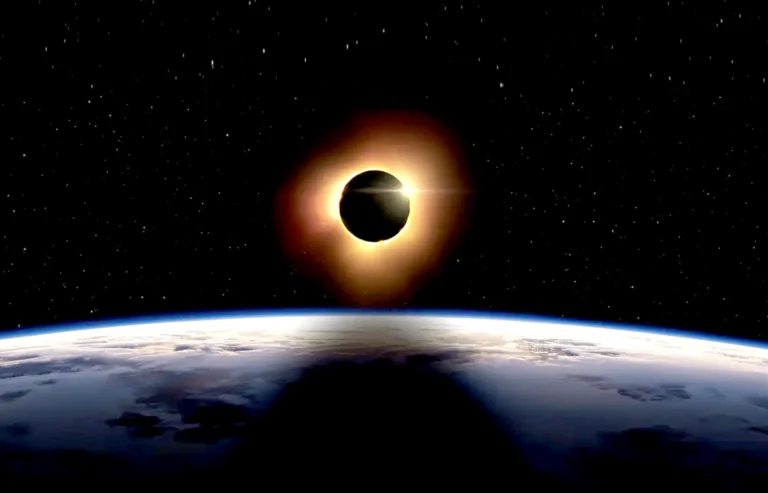
A lunar eclipse occurs when the Earth passes between the Sun and the Moon, blocking some of the sunlight reaching the Moon’s surface.
In a penumbral lunar eclipse, the Moon doesn’t enter the Earth’s umbra completely,
but rather passes through the outer part of it.
For this reason, the Moon doesn’t appear the characteristic red color associated with a total lunar eclipse during this type of eclipse.
The change in its brightness is also minimal and may not be easily noticeable to the naked eye.
Large areas of the world are expected to be able to observe the upcoming eclipse.
However, its visibility and timing will vary from region to region depending on the Moon’s position,
the horizon, and atmospheric conditions.
And the eclipse presents an opportunity for amateur astronomers to observe
the Moon’s movement and its interaction with the Earth’s shadow.
It also offers specialists a chance to study the phenomenon and record its various phases using telescopes and astronomical cameras.
List of celestial events
Lunar eclipses vary in nature; there is a total eclipse, during which the moon enters the Earth’s shadow completely, and a
partial eclipse, in which only part of the moon is illuminated. There is also a penumbral eclipse, which has a more subtle visual effect.
Those wishing to witness a more vivid and spectacular lunar eclipse should wait for the upcoming total eclipses,
during which the moon appears more clearly as it enters the Earth’s shadow.
Thus, the moon continues to offer regular opportunities for sky enthusiasts.
The next lunar eclipse is scheduled for February 20, 2027, a highly anticipated astronomical phenomenon
that will be added to the list of celestial events observable in the new year.