
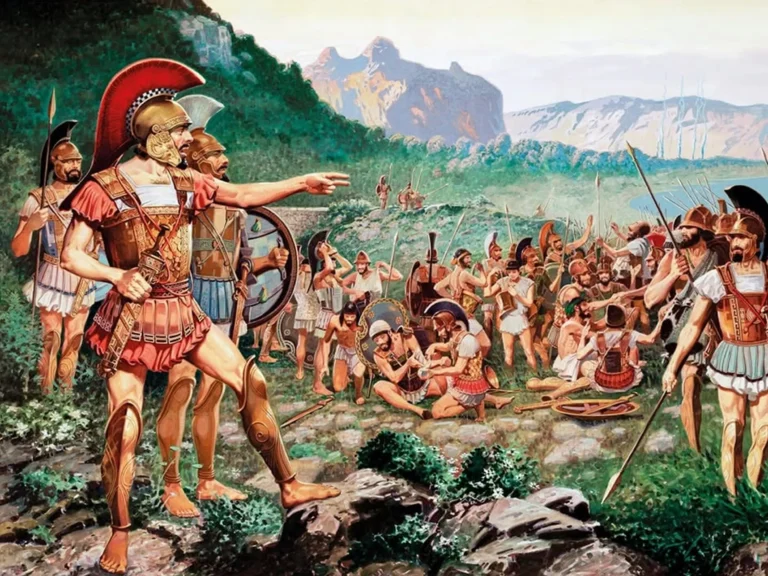
Athens, Greece – King Leonidas I remains etched in the annals of history as one of the most celebrated military leaders of ancient Greece.
His name is synonymous with the Battle of Thermopylae, a battle that became
a symbol of resilience and sacrifice in the face of a formidable Persian army.
Leonidas ruled Sparta during the 5th century BC, a period marked by intense conflict
between the Greek city-states and the Persian Empire, which sought to expand its influence within Greek territory.
Leonidas in an unequal battle
In 480 BC, Greek forces faced the army of the Persian King Xerxes I at the Thermopylae Pass,
a narrow position that offered the defenders a chance to engage
the Persian forces despite their significant numerical advantage.
Leonidas led a force of Spartan warriors alongside fighters from other Greek cities.
The defenders were able to withstand the Persian attacks, benefiting from the terrain.
This terrain limited the Persian army’s ability to exploit its numerical superiority.
However, the Persian forces later discovered a mountain pass
that allowed them to outflank and encircle the defenders.
As the battle became increasingly unequal, Leonidas decided to stay behind
with a portion of his forces and continue the fight.
A battle of courage, discipline, and sacrifice
The battle ended with the death of Leonidas and most of his remaining forces,
but the encounter later became one of the most famous battles
in ancient history, symbolizing courage, discipline, and sacrifice.
The defenders’ resistance also gave the Greek forces time to regroup
and prepare for future engagements with the Persians.
Thermopylae thus became a significant battleground in the Greco-Persian Wars.
More than 2,500 years later, Leonidas story has not faded from memory.
It has become the subject of books, art,
and film, and the Spartan king remains a symbol of a leader who knew
the difficulty of a battle but chose to fight to the end.