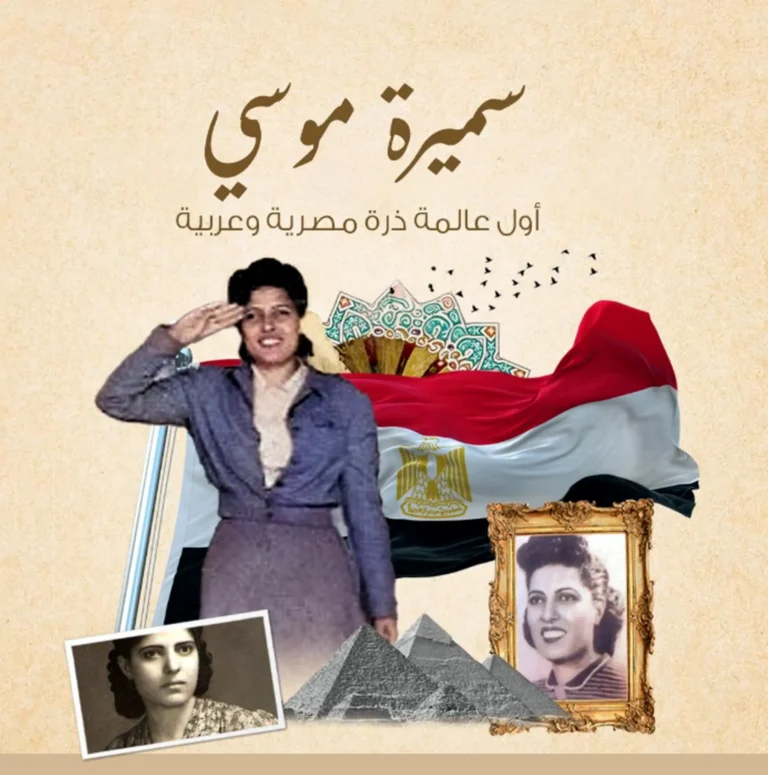
Cairo, Egypt – The late Egyptian scientist Samira Moussa continues to hold a special place in the history of Arab science. She was the first Egyptian woman to specialize in nuclear physics and a symbol of women’s ambition in scientific research.
More than seven decades after her passing, her life story remains a source of inspiration for researchers and students.
Numerous authors and researchers have documented her scientific and humanitarian journey in many books and studies.
Her origins, research, and scientific achievements
Numerous books have chronicled Samira Moussa’s journey from her upbringing in the Gharbia Governorate.
They trace her academic excellence at the Faculty of Science
at Fuad I University (now Cairo University) to her receipt of scholarships to study abroad.
There, she dedicated her research to the peaceful uses of atomic energy.
She believed in its potential for treating diseases and serving humanity, rather than using it for warfare.
The books also highlight her early scientific achievements,
noting that she became the first female teaching assistant at the Faculty of Science
and contributed to research in nuclear physics.
She advocated for making radiation therapy affordable and accessible,
which established her as one of the most prominent scientific figures
in the Arab world during the first half of the 20th century.
An inspiring example in the history of Egypt
Biographies have also explored the mysterious circumstances surrounding her death in 1952 while she was in the United States.
She was involved in a car accident that remains controversial to this day.
This occurred amidst accounts suggesting she may have been assassinated because of her scientific research,
a hypothesis that has yet to be definitively proven.
Several authors have dedicated entire chapters to Samira Moussa’s life,
highlighting her determination to excel scientifically and her advocacy for women’s right to education and research.
They have also emphasized her role in encouraging young people to pursue modern sciences,
earning her the nickname “Miss Curie of the East,” in comparison to the Polish scientist Marie Curie.
Researchers believe that the books about Samira Moussa’s life have
not only documented her scientific achievements
but have also presented a comprehensive portrait of her national character and her great ambition.
She remains one of the most inspiring figures in the history of Egypt and the Arab world,
and a symbol of scientific contribution that continues to resonate even decades after her passing.