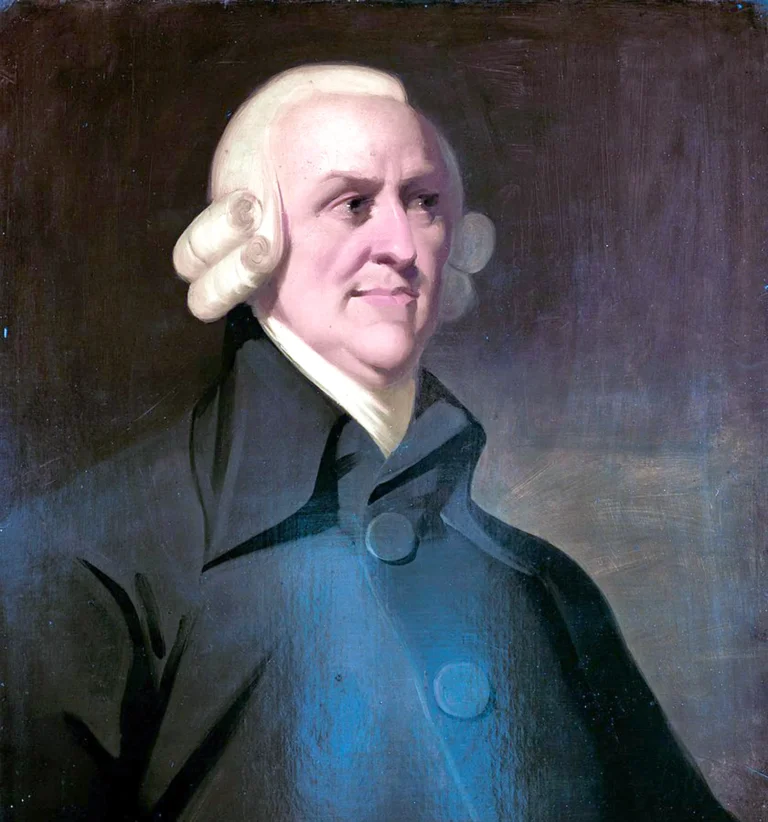
Kirkcaldy, Scotland – Today marks the anniversary of the death of the Scottish philosopher and economist Adam Smith, one of the most influential thinkers in modern history.
Adam Smith remains the intellectual founder of the free market economy,
earning him the title “Father of Modern Capitalism” for his groundbreaking ideas.
His ideas significantly transformed the course of global economic thought.
Adam Smith was born in 1723 in Kirkcaldy, Scotland, and studied philosophy and ethics before turning to political economy.
In 1776, he published his famous book, The Wealth of Nations,
which became one of the most important economic texts in history.
In it, he laid the theoretical foundations for modern capitalism.
The Invisible Hand Theory
Smith is best known for his “invisible hand” theory, which posits that the pursuit of self-interest by individuals
within a free and competitive market indirectly leads to the common good.
This occurs through the mechanisms of supply and demand and competition,
without the need for extensive government intervention in economic activity.
He also paid close attention to the principle of the division of labor.
He explained that distributing tasks among workers increases productivity,
reduces costs, and improves work efficiency.
He considered this one of the most important drivers of economic
growth and industrial development.
Smith and the Role of the State
Despite his association with capitalism, Smith was not an advocate for the complete absence of the state.
In fact, he emphasized the importance of its intervention in areas
such as security, justice, infrastructure, and education.
He considered these responsibilities to be beyond the capacity of markets alone.
Adam Smith died on July 17, 1790, at the age of 67.
Nevertheless, his ideas remain a key reference for economists and policymakers worldwide,
and he remains one of the most influential thinkers in the history of modern economics.