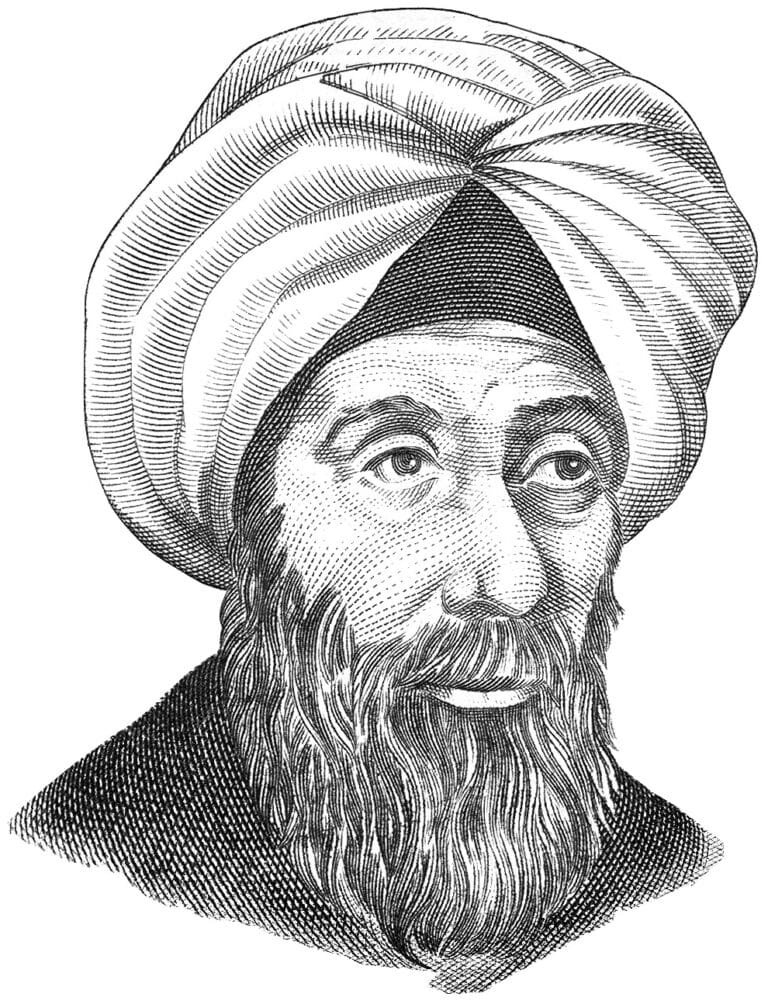
Cairo, Egypt – The Muslim scientist Hassan Ibn al-Haytham is considered one of the greatest scientific figures in the history of human civilization. He sparked a knowledge revolution in the study of light and vision, laid the solid foundations upon which modern optical sciences were built, and established the scientific method based on observation and experimentation—centuries before the dawn of the European Renaissance.
Upbringing and Scientific Formation
Abu Ali al-Hasan ibn al-Haytham was born in 965 AD in the city of Basra, which was a beacon of science in the Islamic world. He grew up in a stimulating scientific environment, enabling him to master mathematics, geometry, medicine, astronomy, and philosophy, eventually becoming one of the most brilliant minds produced during the eras of scientific prosperity.
Cairo: The Theater of Creativity and Research
Ibn al-Haytham moved to Egypt during the reign of the Fatimid Caliph Al-Hakim bi-Amr Allah after his fame spread across the Islamic world. Historical sources mention his attempt to regulate the waters of the Nile River to reduce the risks of floods, a task that demonstrated his practical engineering acumen. In Cairo, he dedicated many long years to research and writing, achieving his greatest scientific breakthroughs there.
“Kitab al-Manazir”: The Scientific Revolution in Vision
His immortal book, “Kitab al-Manazir” (Book of Optics), is considered one of the most important scientific documents in human history. In this work, Ibn al-Haytham provided a precise scientific explanation of how vision occurs, refuting ancient Greek theories that claimed rays emanated from the eye to objects. Instead, he proved scientifically that vision occurs as a result of light entering the eye after being reflected from external objects—a discovery that established the rules of physical optics.
Pioneer of the Experimental Method
Ibn al-Haytham’s theories were not mere contemplations; they relied on rigorous practical experiments. He tested his hypotheses and repeated experiments to reach precise and reliable results, which rightfully made him the spiritual father of the experimental method in scientific research—the fundamental pillar upon which modern science rests today.
A Legacy Transcending Continents and Ages
Ibn al-Haytham’s contributions did not stop at optics; they extended to over two hundred works in mathematics, astronomy, and physics. These works moved to Europe through Latin translations, becoming essential references in European universities for centuries and guiding Renaissance scientists in their later discoveries.
Immortality in the Record of Scientists
Ibn al-Haytham passed away in Cairo around 1040 AD, leaving behind an legacy that time cannot erase. His name continues to resonate in global scientific circles as a symbol of Arab and Islamic genius, and a visionary who did not just explain the phenomena of the universe, but taught the world how to study these phenomena with the eye of science and proof.