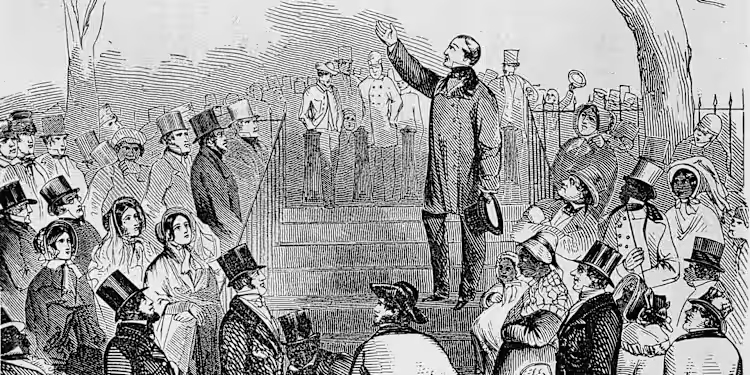
Washington – The renewed historical controversy regarding the issue of slavery in the United States highlights the pivotal role of the first anti-slavery societies. These organizations emerged in the late eighteenth century to confront a system deeply rooted in the economic and social structure of the time. Furthermore, these societies included an elite group of religious activists and thinkers who led extensive moral campaigns. Accordingly, the history of slavery abolition in America represents an epic struggle between human principles and material interests. In this regard, historians are currently seeking a deeper understanding of how society transitioned from forced labor to a free labor market.
Legislative Pressure Campaigns and the Shift Toward Full Emancipation
Anti-slavery societies began extensive campaigns that considered slavery a flagrant violation of human rights and dignity. Obviously, these movements exerted strong pressure on legislative authorities to issue gradual laws leading to full emancipation. As a result, northern states began adopting abolitionist policies long before the outbreak of armed confrontations. In addition, this intellectual movement contributed to enhancing public awareness about the necessity of protecting the history of slavery abolition as a human heritage that cannot be compromised. However, these efforts faced violent resistance in the southern states, which saw abolition as a direct threat to their traditional way of life.
The American Civil War and the 13th Amendment to End Slavery
The United States entered one of its most complex historical phases with the expansion of the abolitionist and liberation movement. Certainly, the American Civil War (1861–1865) constituted the decisive turning point that ended the political debate over the legality of slavery. Accordingly, the Thirteenth Amendment was passed, officially banning slavery throughout the country. On the other hand, researchers believe that this step was not just a legal decision, but a comprehensive redrafting of the American identity. In the same context, the history of slavery abolition remains a witness to the heavy price the nation paid to achieve justice and equality among its citizens.
Economic Crises in the South and the Controversy of the Reconstruction Era
Some controversial historical readings indicate that the process of abolition caused acute economic and social crises in the American South. Obviously, the long-term reliance of agriculture on the forced labor system made the sudden transition to a free market system painful. As a result, a large economic gap emerged, leading to widespread unrest during the famous Reconstruction era. In addition, historians emphasize that the lack of adequate preparation for the newly freed individuals made their integration into society face enormous challenges. However, this economic controversy does not diminish the moral importance of the decision to end the system of exploitation that lasted for centuries under the title of the history of slavery abolition.