
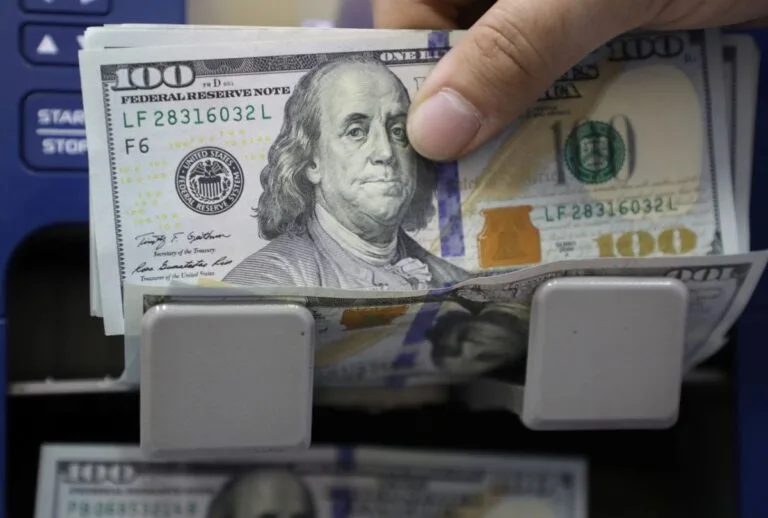
Cairo, Egypt – The US dollar saw a significant rise against the Egyptian pound in the local banking market on Monday. The dollar broke through the 51-pound mark in some banks, ending a period of relative stability around 49 pounds. This price movement is driven by regional geopolitical pressures that have slowed investment flows. Additionally, there has been a renewed outflow of “hot money” from emerging markets.
Dollar exchange rates in banks today
Dollar exchange rates varied across Egyptian banks. The National Bank of Kuwait, Suez Canal Bank, and Al-Ahli Bank of Kuwait recorded the highest rates at 51.42 Egyptian pounds for buying and 51.52 Egyptian pounds for selling.
While prices at other banks were as follows:
Next Bank: 51.30 EGP to buy, 51.40 EGP to sell.
Arab International Bank: 51.23 EGP for buying, 51.33 EGP for selling.
National Bank of Egypt: 51.22 Egyptian pounds for buying, 51.32 Egyptian pounds for selling.
HSBC Bank: 51.19 EGP for buying, 51.29 EGP for selling.
Faisal Islamic Bank and United Bank: 51.18 EGP for buying, 51.28 EGP for selling.
Bank of Alexandria: 51.16 EGP for buying, 51.26 EGP for selling.
Banks (Credit Agricole, Al Baraka, Misr, Midbank): 51.15 EGP for buying, 51.25 EGP for selling.
Influencing factors: hot money and tensions
Data from the Egyptian Stock Exchange indicates that the secondary market for government debt saw net selling by foreign and Arab investors of $1.46 billion last week. This shift reflects renewed regional geopolitical tensions that have revived investor concerns. This has led to a change in their investment direction following a period of positive performance in the second quarter of 2020, which saw inflows of $11.66 billion in “hot money.”
Economic foundations and reserve strength
Despite current exchange rate pressures, the Egyptian economy possesses strong fundamentals. Net foreign exchange reserves reached a record high of $55.07 billion last June. Remittances from Egyptians abroad also play a crucial role in absorbing shocks, having jumped by 33.2% between July 2025 and April 2026, reaching $39.2 billion. Experts assert that this exchange rate fluctuation is a natural reflection of the volatility in risk appetite among international investors due to the turbulent regional situation. There is also anticipation regarding how the monetary authorities will manage these fluctuations given the abundance of international reserves, which are the highest in the country’s history.