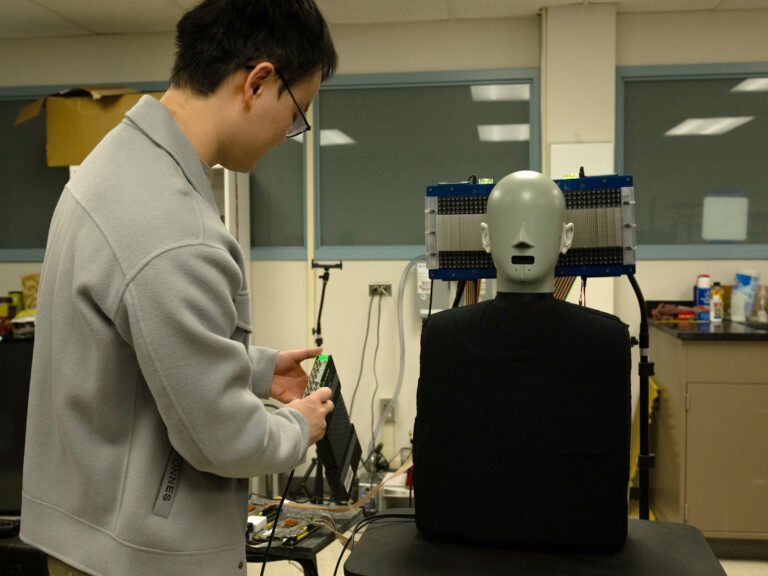
Seoul – South Korea — In a striking technical and engineering breakthrough within the field of bio-acoustics and sound technology, international researchers have unveiled a revolutionary audio framework. This new system empowers users to stream music and acoustic content with high fidelity completely free of traditional earphones, while simultaneously preventing any noise leakage to individuals standing in close proximity. This strategic evolution possesses the potential to fundamentally redefine and reshape personal audio consumption within public and communal environments.
Focused Sound Beams and Dismantling Traditional Wave Dispersion
This innovative technology relies on advanced algorithms and precision mechanical engineering designed to direct acoustic waves with absolute accuracy toward the target user’s ears via what is scientifically classified as a “Focused Sound Beam.” Due to this dynamic vectoring, the sound waves do not disperse or scatter across the surrounding spatial environment like conventional speakers typically do. This unique structural control ensures that the transmitted audio is completely audible to only a single individual positioned within a highly calibrated, specific range.
Developers and acoustic engineers project that this intelligent technology presents an excellent practical and spatial solution for noise-sensitive working and learning ecosystems. It is tailored for environments such as public libraries, mass transit systems, and corporate open-plan offices. In these settings, individuals can fluidly stream lectures, music, or interactive multimedia with total freedom, avoiding the physical fatigue of wearing earpieces for extended periods, all without generating any noise pollution for those around them.
Entertainment Horizons and Engineering Calibration Challenges
Furthermore, this architectural audio advancement unlocks the door to a sweeping array of commercial and industrial applications. These include the optimization of localized smart entertainment modules inside vehicles—where each passenger experiences independent audio feeds—the enhancement of interactive exhibition displays in museums, and the deployment of digital educational platforms requiring complete acoustic autonomy for individual students occupying the exact same lecture hall or classroom.
Despite the intense academic and commercial enthusiasm backing this innovation, expert audio engineers emphasize that the most critical technical challenge at present involves precisely tracking user movement to maintain continuous audio targeting and eliminate side-leakage. This challenge runs alongside the necessity of preserving pristine sound definition and stable frequency responses across chaotic, structurally fluctuating ambient environments.
Lead researchers confirm that while this technology remains in the laboratory refinement and calibration phase, it undoubtedly represents the foundational cornerstone of a brand-new future for personalized and interactive audio. It seamlessly synthesizes absolute privacy with maximum comfort, entirely removing the structural reliance on any additional wearable hardware.