
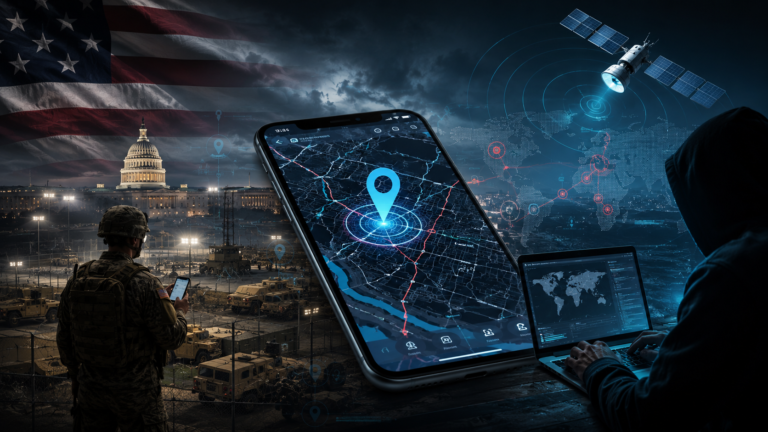
Washington, DC – Warnings are mounting within the United States regarding the growing risks posed by geolocation data, as smartphones, digital applications, and social media platforms have become a massive source of sensitive information that can be exploited to threaten US national security. Reports from US intelligence and security agencies indicate that geolocation data is no longer merely a technical tool used in maps or commercial applications. It has transformed into a strategic element that can reveal the movements of military personnel, the locations of sensitive facilities, and the travel patterns of government officials.
Modern technology opens up wide security gaps
According to recent US security assessments, smartphone apps capable of tracking geolocation collect massive amounts of data daily, including users’ movements, behavior, and digital activities. US security agencies believe the danger of this data lies in its potential to be analyzed and linked to maps of critical infrastructure, military bases, or strategic installations. Intelligence reports also warn that foreign entities, whether rival nations or cyber groups, could use this data to monitor military movements. Furthermore, they could use it to build detailed databases on lifestyles within the United States.
Fears of attacks targeting military personnel and sensitive installations
Several incidents in recent years have raised widespread concern within the US defense establishment, after sports apps and location services revealed the locations of military bases and the movements of US military personnel in sensitive areas around the world. Cybersecurity experts believe that location data can become an effective intelligence tool when combined with artificial intelligence and big data analytics. This allows for the creation of precise maps of military movements and security activities. Washington also fears that this information could be used to plan cyberattacks or sophisticated surveillance operations targeting government institutions and critical infrastructure.
Artificial intelligence increases the scale of the threat
Security studies confirm that the rapid development of artificial intelligence and data analytics technologies has made it possible to extract sensitive information from seemingly ordinary or insignificant data. Simply knowing patterns of movement or frequent presence in specific locations can reveal the identities of security personnel or strategic facilities. American security agencies consider this type of “unconventional threat” to be an escalating challenge in the coming years, especially with the expansion of 5G networks and the increasing reliance on smart devices and internet-connected drones.
Tightening control over technology companies
These concerns have prompted the US administration to tighten its oversight of certain foreign technology companies and applications that collect user data within the United States. This comes amid accusations that some of this data could fall into the hands of foreign governments or intelligence agencies. US lawmakers are also debating new legislation aimed at limiting the collection of sensitive geolocation data and imposing stricter controls on the sharing of personal location information, particularly that of military and security personnel.
Location data is becoming a strategic weapon
Analysts believe that location data has become part of the global struggle for information control and technological supremacy. Modern warfare no longer relies solely on conventional weapons; data has become a crucial element of national security and competition between major powers. Experts emphasize that the greatest challenge facing the United States is not limited to protecting its borders or military installations, but extends to safeguarding the “everyday data” generated by millions of users on their smart devices, which could transform into a strategic threat at any moment.