- global economic repercussions
- The US strategy: between escalation and diplomacy
- The fate of the Strait of Hormuz and war scenarios
- widespread economic drain
- The inevitability of profit and loss
- Demonstrations in the United States
- The size and scope of the protests and the Egyptian elections
- Internal pressures and external challenges
Exclusive, Voice of the Emirates – The world stands today at a perilous historical crossroads, amidst a war whose fronts are multiplying and whose repercussions are escalating at a pace unseen in the international system for decades.
While Washington wavers between the option of a decisive military strike and the search for a diplomatic solution,
the global economy groans under the weight of an unprecedented energy crisis,
while millions of Americans take to the streets in a wave of protests that is reshaping
the domestic political landscape and casting a heavy shadow over the future of President Donald Trump’s administration.
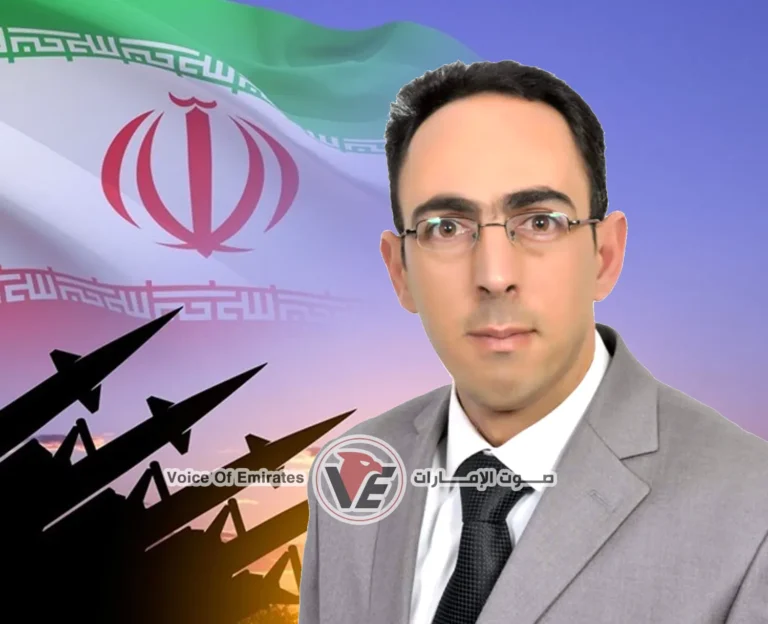
Professor Hussein Al-Deek, a professor of international relations and an expert on Israeli affairs,
warned in exclusive statements to “Sawt Al-Emarat” of the profound economic and political repercussions of the current war,
stressing that the world is facing one of the most dangerous complex crises that combines military tensions,
economic contraction, and instability in energy markets.
global economic repercussions
Al-Deek explained that the economic repercussions of the war are not limited to the direct parties to the conflict,
but extend to the entire global economy, noting that international markets
are already suffering from unprecedented turmoil, particularly in the energy sector.
He added that oil and gas prices are experiencing sharp fluctuations due to fears of the conflict escalating.
This directly impacts production and transportation costs and global supply chains.
He emphasized that the global economy has never witnessed a crisis of this magnitude before,
where geopolitical factors intertwine with inflationary pressures and rising interest rates,
which places countries, especially developing ones, before major economic challenges that may persist for years even after the war ends.
The US strategy: between escalation and diplomacy
In a related context, Al-Deek pointed out that the US administration is trying to manage
the crisis through a combination of political and military tools,
noting that President Donald Trump is adopting a wavering strategy that combines the threat of military
escalation on the one hand, and engagement in diplomatic paths on the other.
He explained that this duality reflects an attempt to pressure adversaries and achieve political gains
without sliding into a full-blown war, although the potential for escalation remains high.
He added that it is still too early to predict when the war will end, explaining that the possible scenarios range
from a swift cessation within a few weeks to a conflict lasting for months, or perhaps even longer,
given what he described as a “deep crisis of confidence” between the United States and Iran.
He emphasized that the negotiating process has not yet truly begun and continues to face complex political and strategic obstacles.
The fate of the Strait of Hormuz and war scenarios
Al-Deek addressed the importance of the Strait of Hormuz in the conflict equation,
arguing that Iran has thus far successfully used it as a strategic pressure point on the international community,
given the strait’s crucial role in transporting a significant portion of the world’s oil supply.
However, he cautioned that this leverage could lose its value in the event of a direct military intervention
aimed at seizing control of Iranian coasts or islands, which could fundamentally alter the dynamics of the conflict.
In his analysis of near-term scenarios, Al-Deek predicted that the coming hours or days could be decisive,
suggesting the possibility of a large-scale military operation inside Iranian territory using unconventional methods,
with the goal of achieving a swift victory that could be politically exploited.
widespread economic drain
He argued that such a scenario could later pave the way for a move to the negotiating table from a position of strength.
Regarding the economic cost of the conflict, Al-Deek emphasized
that the continuation of the war would significantly increase the cost to the global economy,
whether through higher energy prices, disruption of international trade,
or a decline in investment. He explained that these pressures might push major powers to accelerate
their efforts to resolve the conflict, given the extensive economic drain it is causing.
The inevitability of profit and loss
He emphasized that major wars do not usually end with compromises, but rather produce a winner and a loser,
noting that the United States and Israel will not accept withdrawing from this confrontation without achieving clear gains,
which further complicates the chances of reaching a swift settlement.
On a broader level, Al-Deek believes that the region is undergoing
a historic transformation that could completely redraw the map of the Middle East.
He explained that the consequences of this confrontation will not be limited to Iran,
but will affect regional power balances and may lead to the end of the influence of non-state actors that have played a pivotal role in recent years.
He pointed to an international and regional trend toward ending the phenomenon of “non-state actors,”
considering the current phase to be the implementation of this trend,
through reducing the role of armed militias and restoring the nation-state as the center of authority.
Demonstrations in the United States
In another context, Al-Deek addressed the internal situation in the United States,
highlighting the widespread demonstrations taking place across the country in protest against the current administration’s policies.
He considered these protests to reflect a deep political and social divide,
with a wide spectrum of groups participating, including human rights organizations, unions, and independent activists.
He explained that the reasons for these demonstrations are numerous, most notably the rejection of war and military escalation,
along with objections to economic and immigration policies, as well as concerns related to freedoms and democracy.
He added that rising prices, particularly in the energy and food sectors,
were a significant factor in driving large numbers of citizens to the streets.
The size and scope of the protests and the Egyptian elections
He noted that the protests encompassed various US states, with millions of participants,
making it one of the largest waves of popular mobilization in the country’s modern history.
While most were peaceful, some cities witnessed minor clashes.
He pointed out that the US administration downplayed the significance of these protests,
but they actually represent increasing political pressure that could influence its decisions,
especially with the elections approaching. Regarding the electoral landscape,
he clarified that the upcoming elections will only affect the renewal of members of Congress, without impacting the presidency.
He predicted that the Democratic Party would make significant gains, particularly
in the House of Representatives, which could limit the administration’s ability to pass its policies.
He noted that opposition control of the House could paralyze many government initiatives,
both domestic and foreign, further complicating the political landscape in Washington.
He then reviewed the historical context of protests in the United States,
emphasizing that this phenomenon is not new, but rather has occurred throughout history,
especially during major wars such as the Vietnam War, where protests played
a significant role in shaping public opinion and influencing political decisions.
Internal pressures and external challenges
He concluded by emphasizing that the current popular movement reflects the vitality of American society,
but at the same time poses a real challenge to the administration, especially given its concurrence with complex foreign crises.
He stressed that the core message of these protests is a rejection of involvement in new wars
and a focus on the economic and livelihood issues of citizens.
He indicated that the continuation of this popular momentum may push policymakers to reconsider their policies,
both domestic and foreign, in an attempt to contain public anger
and avoid broader political repercussions in the future.