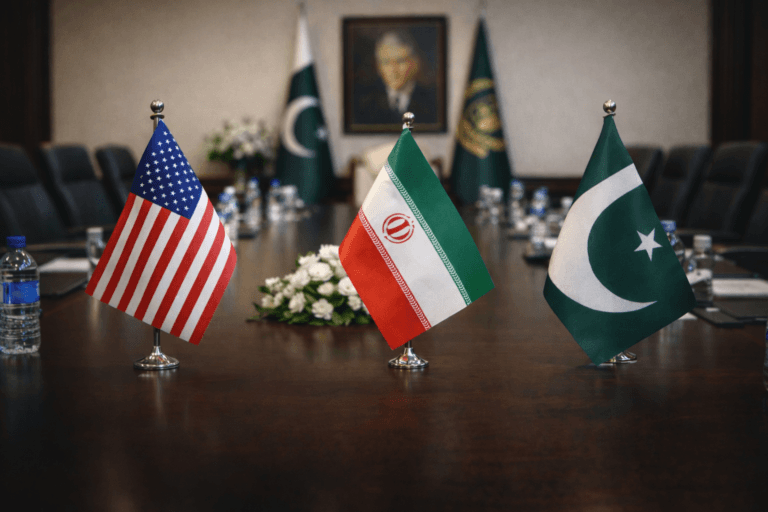
Dubai, UAE – The talks in Islamabad on Saturday, April 11, 2026, come at a highly sensitive regional moment, amid a fragile truce and deep disagreements over the terms of its consolidation. According to available reports, Pakistan hosted meetings between US and Iranian officials, with direct mediation from Prime Minister Shehbaz Sharif. This process thus far appears more like a test of political intentions than a fully-fledged final settlement.
The UAE’s position on the US-Iran negotiations
The UAE does not appear to reject negotiations in principle; in fact, it welcomed the US-Iranian talks hosted by Oman on February 7, 2026, describing them as a positive step reflecting support for dialogue and de-escalation. This indicates that Abu Dhabi views negotiation as a legitimate tool for reducing tensions. However, it stipulates that this must not come at the expense of national sovereignty or regional security.
Iranian attacks on the UAE
In contrast, the UAE’s stance toward Iran following the recent attacks was very clear. In official statements issued in late February and early March 2026, the UAE Ministry of Foreign Affairs described the Iranian attacks as an unjustified act of aggression and a flagrant violation of international law and the UN Charter. It also confirmed that the attacks targeted UAE territory, civilian sites, and infrastructure. On March 1, 2026, Abu Dhabi announced the closure of its embassy in Tehran and the withdrawal of its ambassador and diplomatic staff. Then, on March 2, it summoned the Iranian ambassador and delivered a strongly worded protest note.
Why does the UAE support de-escalation but refuse to move beyond the issue of compensation?
This balance explains the nature of the current Emirati approach: supporting any path that halts the security deterioration. However, it clearly rejects any attempt to transform de-escalation into a formula that ignores legal and political responsibility for the attacks. On March 17, 2026, the UAE officially emphasized that Iran bears full responsibility for the casualties and damage resulting from its unlawful armed attacks. This demonstrates the UAE’s insistence that any genuine de-escalation must be accompanied by accountability, compensation, and guarantees of non-recurrence.
UAE compensation for Iranian attacks
In practical terms, Abu Dhabi appears to be pushing for the principle of compensation to be enshrined as part of any future political arrangements, rather than treated as a separate issue that can be postponed indefinitely. This likely includes, at most, demands for compensation for direct damage to infrastructure, civilian facilities, and the economy. It also links this to the principle of international responsibility for wrongful acts. The UAE has politically supported this approach by welcoming UN Security Council Resolution 2817, adopted on March 12, 2016. This resolution condemned the Iranian attacks and demanded their immediate cessation.
UAE’s legal options against Iran
Legal options exist, but not all are easy to implement. The most realistic path often remains direct or indirect political negotiation on a compensation mechanism. Steps such as establishing a claims commission, a special fund, or an interim understanding linking de-escalation to reparations can be taken. International judicial avenues are possible in principle, but they require a clear jurisdictional basis and appropriate legal consent from the parties involved. This makes them more complex and slower than political solutions backed by international support.
The UAE and the Strait of Hormuz after the escalation
The Strait of Hormuz is a key element in the UAE’s approach to the ongoing negotiations. On April 8, 2026, the UAE expressed its disappointment at the Security Council’s failure to adopt a resolution concerning the protection of freedom of navigation. It had also participated in a joint statement on March 21, 2026, calling on Iran to cease its threats and attempts to disrupt commercial shipping in the Strait. The UAE further emphasized that freedom of navigation is a fundamental principle of international law. All of this indicates that Abu Dhabi views the security of maritime routes as an integral part of any political or security settlement with Tehran.
What does Abu Dhabi want from the Islamabad negotiations?
In practice, the UAE appears to want more from the Islamabad talks than just a temporary truce. It seeks a path that effectively halts attacks, prevents their recurrence, and protects navigation and trade. It also aims to establish that any aggression against its territory will have political, legal, and financial consequences. Therefore, its position can be described as cautious support: no obstruction of diplomacy. But it will not accept a settlement that infringes upon sovereignty or relinquishes the right to compensation.
Which scenario is most likely?
The most likely scenario, based on current information, is that the UAE will continue to support de-escalation in principle, while simultaneously working to solidify the issues of responsibility and compensation in international and regional forums. If the Islamabad talks succeed in opening a broader avenue for understanding, compensation could become part of a larger political agreement. However, if the negotiations remain limited or temporary, Abu Dhabi will likely continue to utilize its diplomatic and international tools to press for full recognition of its legal and sovereign rights.