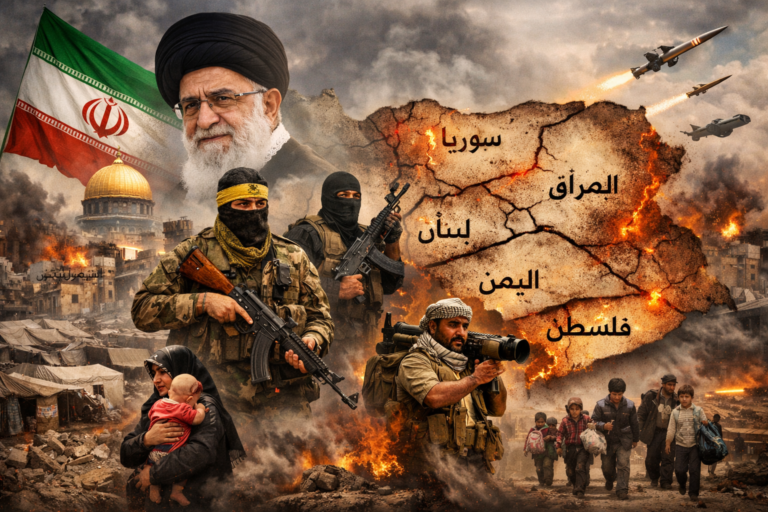
Dubai, UAE – Over the past four decades, specifically since the 1979 Iranian Revolution, the Middle East has witnessed a fundamental shift in Iranian military and political doctrine. Tehran has moved from a phase of revolutionary ideological proselytizing to one of “field engineering” of Arab societies through a strategy of “decentralization.” This Iranian vision structurally relies on creating a complex network of armed proxies and non-state actors operating in gray areas outside the framework of national sovereignty.
An examination of field records and international human rights reports, such as those by the Stockholm International Peace Research Institute (SIPRI), clearly reveals that this strategy was not aimed at building traditional political influence, but rather at transforming Arab geography into sovereign “black holes.” Through these black holes, Tehran ensures that the host state remains in a state of perpetual weakness, preventing it from making any national decisions that conflict with the regional agenda of the Iranian Revolutionary Guard Corps (IRGC), thus rendering sovereignty a mere legal facade for a reality dominated by militias.
Proxies and victims
The most tragic irony of this strategy becomes apparent when considering the fate of the Palestinian refugee camps in neighboring countries, which have long been used in Iranian media discourse as a symbol of mobilization and revolutionary legitimacy. Looking back at the documented history of the “War of the Camps” in Lebanon (1985-1988), we find that the Amal Movement, which at the time received crucial support from Tehran to consolidate armed Shiite influence, launched bloody attacks on the Sabra, Shatila, and Burj al-Barajneh camps. An official Lebanese government report at the time stated that 3,781 people were killed and 6,787 others were wounded, in addition to the victims of the internal Palestinian fighting fueled by regional polarization.
This approach was not confined to Lebanon; in Iraq after 2003, Palestinians became a direct target of Iranian-backed militias such as the Badr Corps. International organizations such as Human Rights Watch and Amnesty International documented systematic killings, displacement, and kidnappings, leading to the mass exodus of thousands of Palestinians who found themselves victims of sectarian and political score-settling in which they had no part.
In Syria, the targeting reached its peak in Yarmouk camp (2012-2018), which housed approximately 160,000 Palestinians before the war. The camp was subjected to a prolonged siege involving militias loyal to Tehran, most notably the 313th Battalion of the Imam Hussein Brigade. By the end of the siege, the camp had been almost entirely emptied of its inhabitants. Palestinian human rights organizations documented the Ali al-Wahsh Street massacre in southern Damascus in 2014, where Iraqi factions and regime forces killed more than 1,500 people, with at least 1,033 others documented as missing, in an operation described in reports as “spatial cleansing” under Iranian military cover.
Regional incinerators
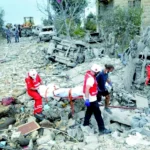
In the context of the major conflagrations witnessed in the region, the Syrian and Yemeni cases stand out as stark examples of the exorbitant human cost of direct and indirect Iranian intervention. In Syria, the involvement of the Quds Force and Hezbollah since 2011 was not merely support for an allied regime, but rather a large-scale “demographic surgery” operation overseen by field commanders like Qassem Soleimani to secure a “land corridor” stretching from Tehran to the Mediterranean coast.
According to the Syrian Observatory for Human Rights’ updated statistics up to March 2025, this intervention has led to the deaths of approximately 656,493 people (including 199,068 civilians) and the displacement of more than 6 million refugees outside the country, turning the Syrian state into an open arena for exporting cross-border crises.
In parallel, Tehran, through its financial and military support for the Houthi militia, has transformed Yemen into a regional battleground. A 2021 report by the United Nations Development Programme (UNDP) indicated that if the war continues until 2030, 1.3 million people will die, 70% of them from indirect causes such as hunger and disease. UN data for 2026 confirms that 18.2 million Yemenis are in dire need of humanitarian assistance, while 17 million suffer from food insecurity. This reality is a consequence of the Houthis’ subservience to Iranian missile and drone platforms, which not only threaten Yemen’s internal security but also directly and continuously threaten international waterways and the security of neighboring Arab states.
The chaos is spreading
The Iranian model of control relies on the principle of “weakening the center to strengthen the proxy.” In Lebanon, Hezbollah’s massive annual funding, estimated by the US State Department at around $700 million, provides a stark example of how the state’s sovereign decision-making is usurped. The party’s involvement in regional conflicts, most recently the “war of support” (2023-2024), has resulted in enormous economic losses, estimated by the World Bank at around $8.5 billion. Independent economic studies have raised this figure to $14 billion when factoring in lost opportunities and the destruction of infrastructure, including some 99,000 housing units that were damaged or destroyed.
In Iraq, Iran’s support for the Popular Mobilization Forces (PMF) and the Badr Corps has created a parallel security structure that weakens the national army and makes Iraqi sovereignty hostage to political maneuvering in Tehran. Human rights organizations have documented the role of these militias in the assassinations of activists and forced displacement, threatening the social fabric of Iraq. This ambition is not limited to the Levant; in Sudan, recent developments have revealed hybrid ideological alliances between the Islamic Revolutionary Guard Corps (IRGC) and the military wing of the Muslim Brotherhood (the al-Bara’ bin Malik Brigade). In March 2026, the United States designated this brigade as a terrorist organization due to its proven involvement in mass executions and its close ties to Tehran, threatening to spread the “militia contagion” to the heart of the African continent and deepen the crisis that has already displaced 12 million Sudanese.
Black pragmatism
Behind these successive crises lies the Iranian regime’s “dark pragmatism,” which transcends all its declared ideological slogans. Despite its “Death to Israel” rhetoric, history records covert intelligence and military cooperation with Israel at pivotal moments. Historical intelligence reports indicate that Iran provided crucial information that helped Israel destroy Iraq’s Tammuz nuclear reactor (Operation Opera, 1981).
The Iran-Contra scandal of the 1980s, which involved the sale of American weapons to Iran through an Israeli intermediary, remains damning evidence that the Iranian regime is willing to ally with any party to ensure its survival and expand its influence, even if it comes at the expense of the slogans it promotes to its proxies in the region.
Forces of stability
In the face of this expansion, a strong vision has emerged, led by the region’s forces of stability, foremost among them the United Arab Emirates. This vision is based on the understanding that Iranian intervention is not merely a political dispute, but rather a major driver of instability aimed at undermining the very concept of the nation-state.
UAE diplomacy has consistently stressed in international forums that safeguarding Arab geography and national security requires restoring the authority of the central state, cutting off the sources of militia financing, and preventing Arab territory from being used as a platform to threaten global security. Confronting this penetration has become an existential necessity, not only to defend borders, but also to protect societies from the sectarian fragmentation that invariably precedes the arrival of Iranian weapons.