Dubai, UAE – The UAE appears particularly sensitive to the Iranian escalation, not only due to its geographical location but also because of its significant role in trade, energy, and shipping. Any tension near its borders quickly impacts shipping, aviation, and market confidence. As a result, the UAE receives considerable attention whenever regional tensions rise.
- The UAE at an energy crossroads
- Dubai and Jebel Ali at the heart of trade activity
- Fujairah adds an important strategic dimension
- Why does the UAE stand out more than others on the scene?
- Regional escalation explains the situation better than direct comparisons.
- UAE: A regional center of stability that is difficult to ignore
- Summary of the scene
The UAE at an energy crossroads
The UAE holds particular importance due to its proximity to one of the world’s most vital oil chokepoints, the Strait of Hormuz. According to the U.S. Energy Information Administration, average oil flow through the strait reached approximately 20 million barrels per day in 2024. This represents roughly 20% of global oil consumption. It was projected to remain at similar levels in 2025. Therefore, any tension in this region is not merely localized. Its impact extends to energy prices, marine insurance, and supply chains.
Dubai and Jebel Ali at the heart of trade activity
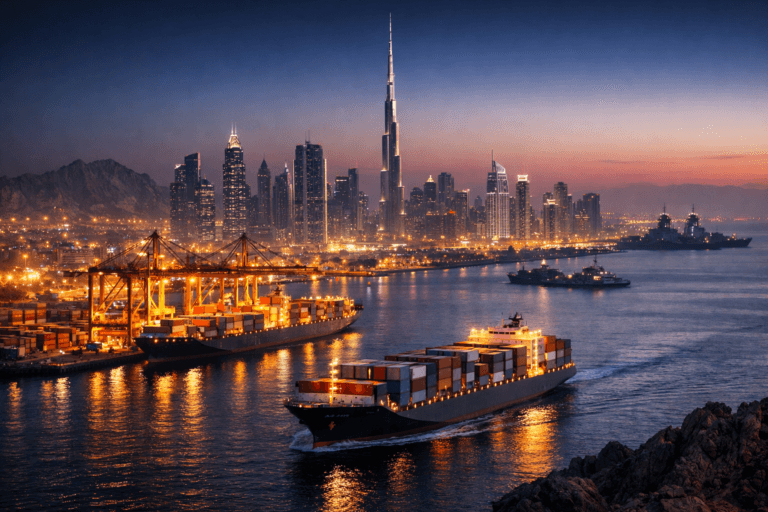
The UAE makes headlines not only because of its geography, but also because of its logistical strength. According to DP World, Jebel Ali Port is connected to more than 150 global ports via over 80 weekly services. This makes it one of the region’s most important trade hubs. Furthermore, Dubai Airports confirms that Dubai International Airport will handle 95.2 million passengers in 2025, its highest annual figure ever. For this reason, any security development near the UAE quickly attracts the attention of markets and the shipping and aviation sectors.
Fujairah adds an important strategic dimension
The UAE’s importance is further amplified by its location, which extends beyond the Arabian Gulf. According to the official UAE government platform, Fujairah is the only emirate situated entirely on the country’s east coast, bordering the Gulf of Oman. This geography, therefore, grants the UAE a significant presence in the maritime and energy equation. It adds strategic depth to any regional analysis of the landscape.
Why does the UAE stand out more than others on the scene?
The answer lies not merely in the number or frequency of incidents, but in the magnitude of the anticipated impact of any threat. A nation possessing major ports and world-class airports, and the ability to connect Asia, Africa, and Europe, naturally becomes a more prominent player in regional calculations. It also attracts greater media and market attention. Therefore, the UAE’s prominence in such developments reflects its significant role in regional stability. It is not simply a matter of its location within a geographically volatile region.
Regional escalation explains the situation better than direct comparisons.
It is important to note here that recent developments, according to the joint statement issued on March 2, 2026, have shown that Iranian attacks have targeted several sovereign territories in the region, including the UAE and a number of other countries. This means that interpreting the situation solely from a “state-to-state” perspective may not be sufficient. A more accurate assessment would be that the entire region is facing an attempt to escalate tensions on security, the economy, and maritime navigation. The UAE’s prominence in this context is also evident, given its significant weight and international influence.
UAE: A regional center of stability that is difficult to ignore
What distinguishes the UAE in this context is that it represents a cornerstone of regional economic stability, not merely a party affected by events. Its location, infrastructure, trade connectivity, and presence in global travel all make the UAE’s security directly linked to the security of trade and energy in the region. Therefore, any developments affecting it appear to have broader implications than their immediate security dimension. Simultaneously, they test the resilience of the regional economy and the confidence of global markets.
Summary of the scene
Ultimately, the UAE’s prominence in the Iranian escalation equation is not solely due to its being the “most targeted” in a purely numerical sense. Rather, it is among the most influential countries when it comes to shipping, energy, aviation, and trade. This status gives any event related to its security resonance that extends far beyond the region. It also makes its stability an integral part of the stability of the global economy itself.