Tehran, Iran – In a new media and military escalation reflecting Tehran’s determination to wage a protracted war of attrition, the Iranian Revolutionary Guard Corps (IRGC) announced its ability to sustain open military confrontation with the United States and Israel for several more months. This signals a shift in the regional balance of power.
This statement comes at a time when the region is witnessing the peak of combat operations. It thus sends a direct message about the size of its military arsenal and its capacity to endure. This is happening under intense air pressure exerted by the Western coalition.
Naini’s statements: A bet on “patience and perseverance”
The Iranian Fars News Agency quoted the official spokesman for the Islamic Revolutionary Guard Corps (IRGC), Ali Mohammad Naeini. He confirmed the operational readiness of the Iranian armed forces.
Naeini stated clearly: “The Iranian armed forces are capable of sustaining an intensive war for at least six months at the current pace of operations.”
This figure (six months) is a direct challenge to intelligence assessments. These assessments predict the crippling of Iranian capabilities as a result of the successive airstrikes.
Observers believe that Tehran is attempting, through this rhetoric, to reassure its domestic front and its allies in the region.
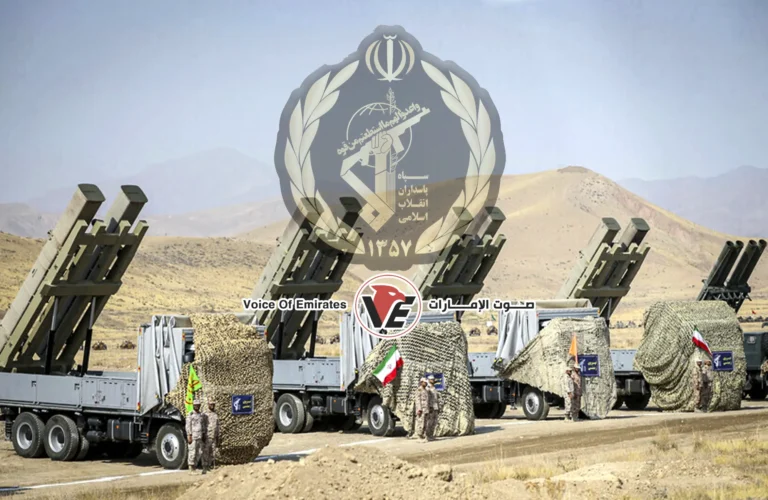
This is because its missile and logistical systems are designed to operate in conditions of “intense warfare” without the need for immediate resupply. Importantly, such resupply could be disrupted by the airstrikes.
Target tally: 200 locations under fire
The Revolutionary Guard spokesman didn’t just talk about the future; he also provided an account of ongoing operations.
He claimed that Iranian forces had already struck more than 200 American and Israeli targets in the region.
The balance of power between reality and claim
Despite this confident tone, the Revolutionary Guard faces formidable challenges on the ground. Field reports indicate that regional air defenses, particularly those of the UAE and Israel, have successfully intercepted the vast majority of these threats. Interception rates exceed 90%.
Nevertheless, the Revolutionary Guard is betting that continued heavy missile launches will eventually deplete the adversaries’ interceptor missile stockpiles.
This, in turn, will create gaps in the air defense system. The coming days will be the true test of the accuracy of the “six-month” figure.
While Tehran speaks of sustaining the fighting, Washington and Tel Aviv continue to destroy Iranian military infrastructure.
This is happening to prevent the confrontation from reaching the timeframe hoped for by the leadership in Tehran.