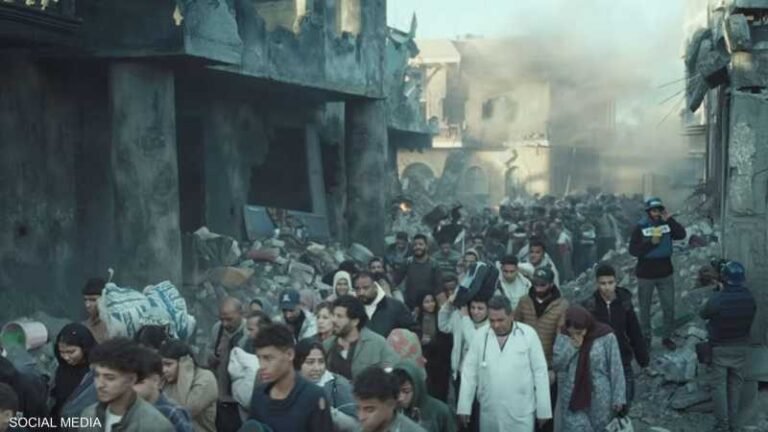
Cairo, Egypt – The series “The People of the Land,” which aired during the Ramadan 2026 drama season, sparked mixed political and media reactions after it dealt with events inspired by the war on Gaza, and the subsequent official and media reactions within Israel, in contrast to a wave of support from Arab media and cultural figures.
Official and media Israeli criticism
The Israeli army spokesperson attacked the series in statements and posts on the “X” platform, claiming it “presents a biased narrative” and “distorts the facts.” Israeli media also addressed the series as part of a “mobilization campaign” reflecting an Egyptian political vision supportive of the Palestinian narrative. Hebrew reports suggested that the timing of the series’ release and its dramatic context give it dimensions that transcend the artistic realm, arguing that drama has become a tool for influencing regional public opinion.
Work creators’ responses
In response, the series’ creators rejected the accusations, asserting that the work is based on “documented facts” and human testimonies. Director Peter Mimi stated on his official account that the series “does not falsify facts,” adding that the visual materials and events it relies on are “available and documented.” For his part, actor Eyad Nassar explained that the series’ aim “is not to create political controversy, but rather to convey a realistic human experience,” emphasizing that the work focuses on the suffering of civilians during times of conflict.
Arab media and parliamentary support
On the Arab side, a number of journalists and parliamentarians expressed their support for the series, considering it to shed light on “human suffering” and reflect a cultural stance supportive of Palestinian rights. Journalist Mustafa Bakri wrote that the series “reflects the constants of the Egyptian position on the Palestinian cause,” while journalist Fairouz Makki considered that art “documents national memory and preserves the historical narrative.”
Widespread interaction on social media platforms
Social media platforms witnessed significant engagement with the airing of the first episodes, with opinions divided between supporters who saw the work as an important human documentary and critics who considered it overtly political. Hashtags related to the series trended in Egypt and several other Arab countries during its initial broadcast.
Political and cultural dimensions
Observers believe that the controversy surrounding the series “The Landowners” reflects the growing role of television drama in shaping political and cultural narratives in the region, particularly given the intertwining of media and art during times of conflict. The debate also reflects the sensitivity of dramatic treatment of the Palestinian issue, a central political topic in both Arab and Israeli discourse. Amid Israeli accusations of “politicizing drama” and Egyptian and Arab defenses of “artistic narrative freedom,” the series has become a model for the intersection of culture and politics in the Middle East, where drama is no longer merely entertainment but an active element in the battle of narratives and messages.