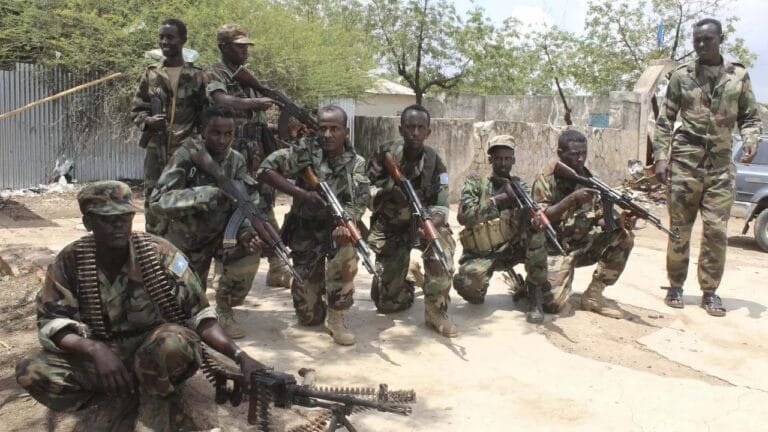
Washington, DC – The Washington-based Africa Center for Strategic Studies (ACSS) has warned that Somalia is entering a dangerous phase of extreme fragility. This is driven by the disintegration of the federal system and escalating regional rivalries. This situation is compounded by the country’s increasing vulnerability to becoming a “jihadist state” if current trends continue.
Youth attack and the fracturing of the federal system
Under the title “Somalia at Risk of Becoming a Jihadist State,” the report highlighted the growing threat posed by al-Shabaab. According to the research center, the group is nearing the ability to seize control of the capital, Mogadishu, exploiting the deep divisions between the federal government and regional states.
Since April 2025, the movement has launched a broad offensive in central Somalia, enabling it to seize strategic towns with little resistance. By July, its forces had advanced to within 50 kilometers of Mogadishu, establishing checkpoints on the city’s outskirts. This prompted several diplomatic missions to evacuate non-essential staff to Kenya. Although the offensive later stalled for unclear reasons, the report concludes that the threat has not diminished.
Al-Shabaab: A rising field force
The al-Shabaab insurgency has been ongoing for nearly two decades, and the group now controls 30% of Somalia’s territory—more than the federal government. Despite a successful US-backed government offensive in 2023, the gains were reversed within months. Al-Shabaab recaptured most of the lost territory and resumed its operations in Mogadishu, most notably the October 2025 attack on the National Intelligence and Security Agency (NISA) branch.
Regional entanglements and external support
The report indicated that the rise of Islamist movements in Somalia has become a central focus of competition among middle powers. The center also linked Qatar and Turkey’s relations with certain Somali forces and parties. It noted Doha’s efforts to open channels of communication with Al-Shabaab under the pretext of paving the way for political negotiations.
However, according to the report, these efforts are rejected in Africa and the West, and do not even have clear acceptance within the movement itself.
Imminent constitutional and political crisis
As the current presidential term nears its end, Somalia is heading toward a deep electoral and constitutional crisis. The study warns that the government’s choice between holding unbalanced elections or no elections at all threatens to plunge the country into political turmoil. This could shatter what remains of the consensus between the central government and the states. It also undermines international confidence in continued financial support and the African Union’s peacekeeping operations (AUSSOM).
Possible collapse scenarios
The report argues that reaching a settlement with al-Shabaab is unrealistic. It cites the group’s messages and hardline rhetoric, which calls for a closed, theocratic regime similar to the Taliban. This rhetoric rejects the constitution, women’s rights, and the arts. The report also warns that any potential negotiations would face resistance from states like Puntland and Jubaland. These two states have demonstrated greater military capability than the federal forces and greater independence from Islamist influence.
If Mogadishu falls, the report anticipates that the capital will become a major financial and military base for the movement. This will be facilitated by their control over port revenues and the weapons stockpiled in the city. This could significantly alter the balance of power in the conflict.
Last chance: a national unity government
The Africa Center for Strategic Studies recommends the formation of a national unity government as a first step toward building a united front against al-Shabaab. This should be done until trust is restored among political actors. The report notes that Villa Somalia’s rejection of this option should not preclude coordination among other military and political forces to confront the common threat.
The report also proposes a scenario for establishing a temporary federal government in a safe alternative capital – such as Baidoa – to continue running the country until Mogadishu is recaptured.
The report asserts that the coming months will be crucial in determining whether Somalia will recover from its crisis, or whether it will enter a new phase of conflict that could alter the dynamics of the war on terror regionally and internationally.