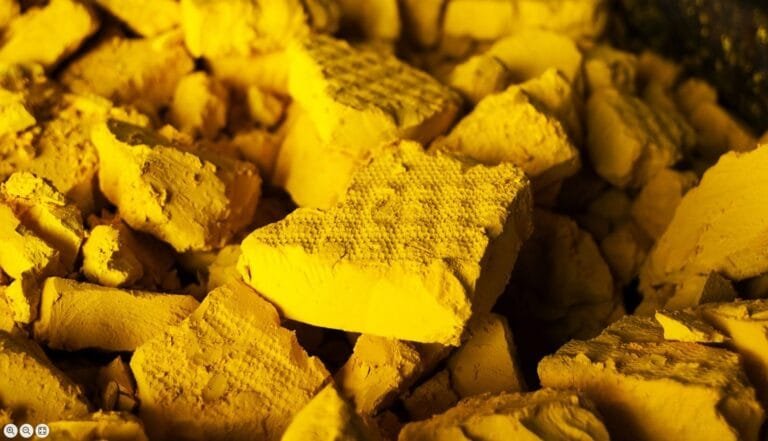
Niger, Voice of the Emirates – Official sources have revealed that the Nigerien government has agreed to sell 1,000 metric tons of natural uranium, known as “yellowcake,” to Russia, according to the French newspaper Le Monde. The deal is valued at $170 million, making it a major strategic move for Niamey and a diplomatic blow to Paris.
The deal comes as part of a major shift in Niger’s foreign policy following the coup by General Abdourahmane Tiéné. This coup led to the expulsion of Western, and particularly French, influence from the country. According to the newspaper, the agreement between the military junta and the Russian company Rosatom aims to transport uranium from the Arlit mine in northern Niger, where approximately 1,400 metric tons are stored. It will be transported to the port of Lomé in Togo before being shipped to Russia.
The importance of the deal for Niger’s economy and foreign policy
Egyptian expert in national security and international relations, Mohamed Abdel Wahed, told “Sawt Al Emarat” that the deal is of utmost importance to Niger, as uranium represents 70% to 80% of the national economy.
Abdelwahed added that this move represents a clear indication of relinquishing Western, particularly French, presence, after Niger expelled the French forces entirely. The assets of the French company “Orano,” which had held a monopoly on uranium extraction since 1971, were also confiscated.
Abdelwahed emphasized that the deal reflects Niger’s intention to diversify its export partners. It does not want to rely solely on France or other Western countries. This indicates a strategic shift in the country’s international relations.
For his part, Mohamed Ali Kilani, director of the Sahel Conflict Monitoring Center, told Voice of the Emirates that Niger, after expelling France, is seeking new partners to maximize its resources. There is an international race to sign partnerships with the Francophone nation. Among these countries are Russia, Turkey, China, and Israel.
Shipment route and insurance procedures
Abdelwahed explained that the uranium would be transported overland, passing through Burkina Faso and Togo, before reaching the port of Lomé, aboard approximately 30 trucks. He confirmed that the Russian side would secure the shipment using ground forces, satellites, and drones, leveraging their military presence in the Sahel region of Africa.
Regarding security risks, Abdul Wahid explained that natural, unenriched uranium (0.7% uranium-235) cannot be used directly to manufacture nuclear bombs. However, it could be used to make so-called “dirty bombs” if the shipment fell into the hands of terrorist groups. But this is a highly unlikely scenario given Russia’s stringent security measures.
Kilani agreed with this assessment, asserting that Russia is capable of securing the shipment from any potential terrorist threats or thefts.
Background of the dispute with France
The deal comes amid long-standing tensions between Niger and France. Niger has accused Paris of trying to deprive it of its natural resources through repeated lawsuits. This was particularly true after the Nigerien government nationalized local uranium mines last June, including a subsidiary of the French company Orano.
The company had resorted to international arbitration. It obtained a provisional ruling prohibiting Niamey from selling the produced uranium to third parties. However, the Nigerian government downplayed the ruling’s impact, asserting that it did not infringe upon the country’s sovereignty or natural resources.
Niger’s Prime Minister, Ali Mahamat-Amin Zene, told the United Nations that his country is facing “French attempts to obstruct the exploitation of its resources.” He stressed that half a century of uranium exploitation has brought nothing but corruption and pollution to the Nigerien people, while France has been the primary beneficiary.