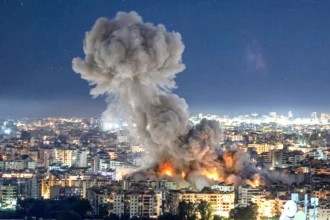
Cairo, Egypt – The US Department of Defense continues to announce massive arms deals with countries in the region, estimated at billions of dollars annually. These deals include the latest fighter jets, air defense systems, and guided missiles, and are publicly presented as a “guarantee for regional security.” However, on the ground, the results appear very different, with tensions escalating and divisions deepening instead of building bridges of stability.
Development is hostage to the arms race
While Arab governments spend tens of billions on arms purchases, essential priorities such as education, health, and infrastructure are declining. International economic reports indicate that some Arab countries allocate nearly 15% of their gross domestic product to military spending. In contrast, much smaller percentages go to development projects. This profound imbalance perpetuates external dependency and renders the region hostage to the giant American arms companies that control the levers of strategic decision-making.
Gaza: A tragedy that reveals contradictions
On the other side of the picture, Palestinians in Gaza are experiencing a complex humanitarian tragedy, facing a stifling blockade and outright famine. While Washington announces urgent humanitarian aid, these statements appear to be mere media facades that do not reflect the reality on the ground. The blockade continues, and the suffering worsens, raising serious questions about America’s role in fueling the crisis rather than resolving it.
Voices accuse Washington of sponsoring the crisis
Criticism does not stop at the double standards of rhetoric; it escalates to the point of accusing the United States of fostering the status quo in Gaza by turning a blind eye to violations and ensuring the continued flow of weapons to Israel. Analysts believe that humanitarian aid, regardless of its value, cannot cover up Washington’s political and moral responsibility for what is happening in the Strip.
The crises in Sudan, Yemen and Syria are in the same equation.
The American approach to the region is not limited to Palestine alone, but extends to other countries such as Sudan, Yemen, and Syria. There, American interests intersect with complex internal crises. In Sudan, the struggle for power coincides with an economic collapse that exacerbates famine. In Yemen, the ongoing war has made the country one of the worst humanitarian crises in the world. Meanwhile, in Syria, the conflict continues to escalate amid the absence of any serious international vision for a solution.
Towards a unified Arab position
Given this bleak picture, there is an urgent need for a unified Arab position. This position must place the priorities of the people above arms deals and impose a new equation that transcends blind subservience to American policies. Without such a position, the region will remain trapped in a cycle of wars. These crises will recur while Washington continues to reap the benefits.