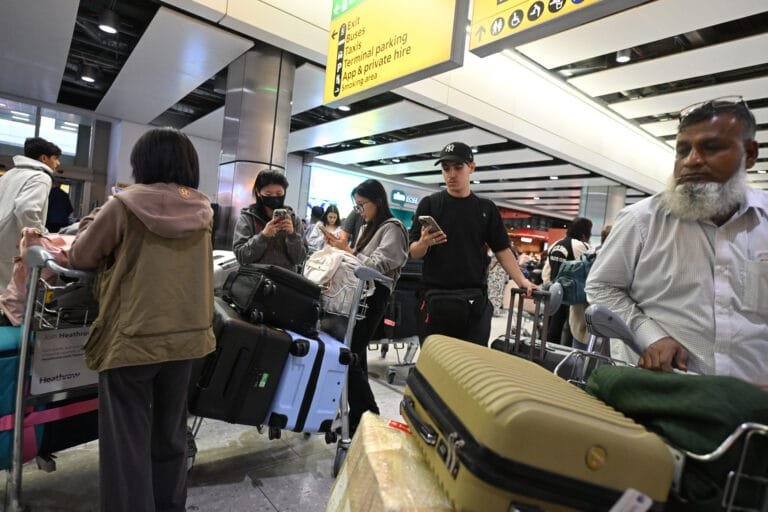
Dubai, United Arab Emirates – Some of Europe’s largest airports, including the region’s busiest Heathrow, continued at a rapid pace on Sunday. They made efforts to restore their usual automated check-in systems. These were disrupted following a cyberattack on Saturday.
It led to a cyber attack on R-owned Collins Aerospace.T.X, which provides a number of airports with check-in and boarding systems. This disrupted operations on Saturday at London Heathrow Airport, as well as Berlin and Brussels airports.
Passengers faced long queues and dozens of cancellations and delays.
Data and airport officials showed that the severity of the defect had eased significantly by Sunday morning.
This is despite some continued delays, while airport-related regulators said they were investigating the source of the attack.
This flaw represents the latest episode in a wave of sophisticated cyber attacks targeting sectors ranging from healthcare to automobiles.
Recently, an infiltration of luxury car company Jaguar Land Rover’s software completely paralyzed its production.
While another hack at Marks & Spencer caused hundreds of millions of pounds in losses.
R. described.T.X This incident is an “electronic glitch”.
She explained that it affected her program (M.Yu.S.e) Used by several airlines.
Berlin Brandenburg Airport said on Sunday that problems still exist and that it is working with the company to solve them. The airport added that it is currently completing the procedures manually until the automated systems are restored. It explained that flight delays or cancellations have become limited.
Brussels Airport said in an updated passenger briefing on Sunday that the cyberattack had a “significant impact.” This caused flight delays and cancellations.
Heathrow Airport announced early Sunday morning that it had begun restoring registration operations after they were interrupted.
“The vast majority of flights continue to operate,” he added.
An analysis by aviation sector data provider Serium showed that delays at Heathrow Airport have become “limited.” In Berlin, delays are “moderate,” while in Brussels they are “significant.” However, they are gradually decreasing.